
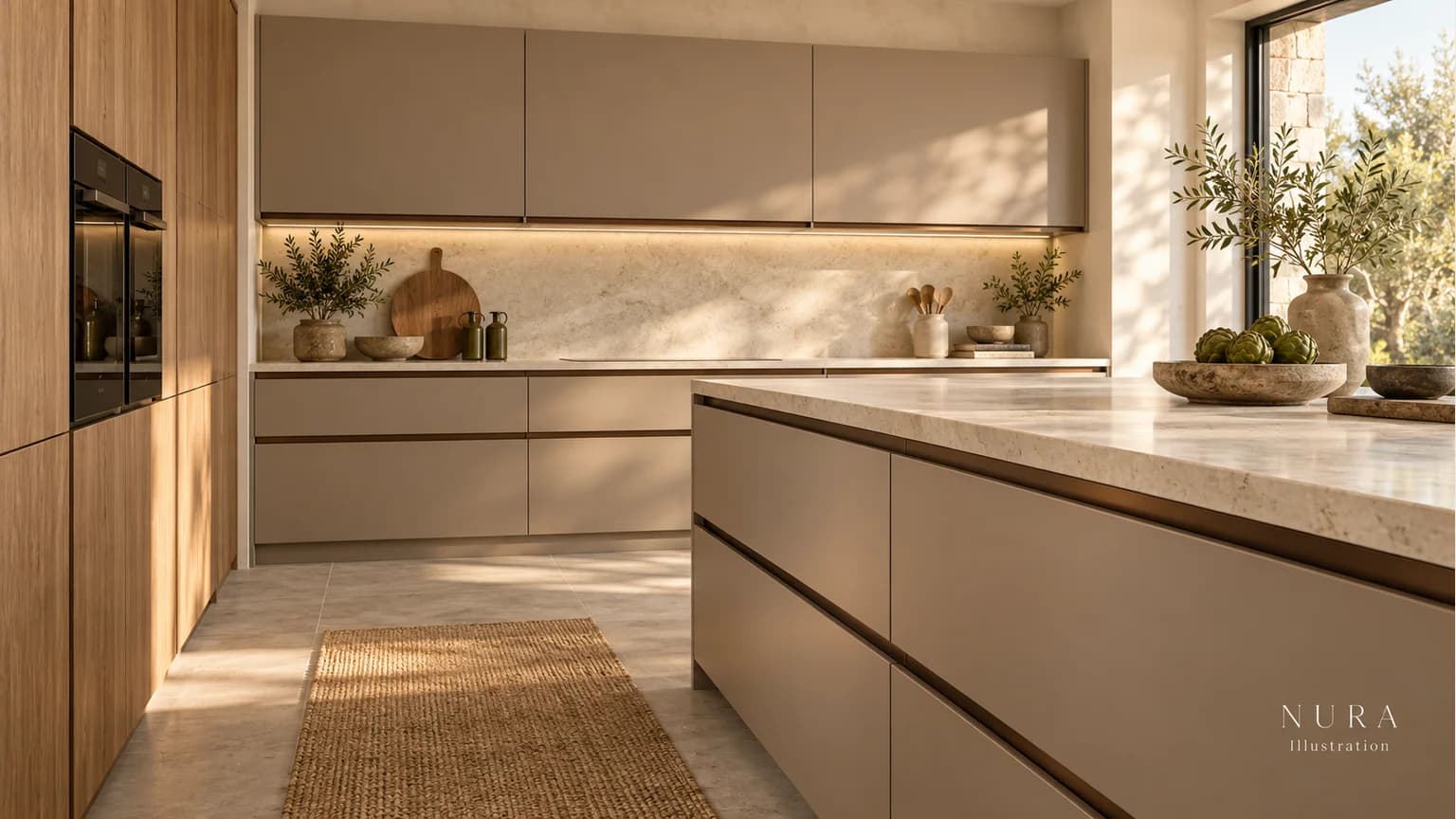

A handleless kitchen can have a shaped finger grip, a recessed rail or a push-to-open mechanism. These can create a similar calm appearance, but your hand does something different with each. Choose the opening action alongside the cabinet layout and finish, rather than leaving it as a final detail.
What are you actually opening?
With J-pull fronts, the grip is shaped into the door or drawer edge. With a recessed rail, often called true handleless, your fingers reach behind the front and pull it towards you. The separate rail becomes part of the visible lines across the cabinetry. Neither description means that the door must first be pushed to release it.
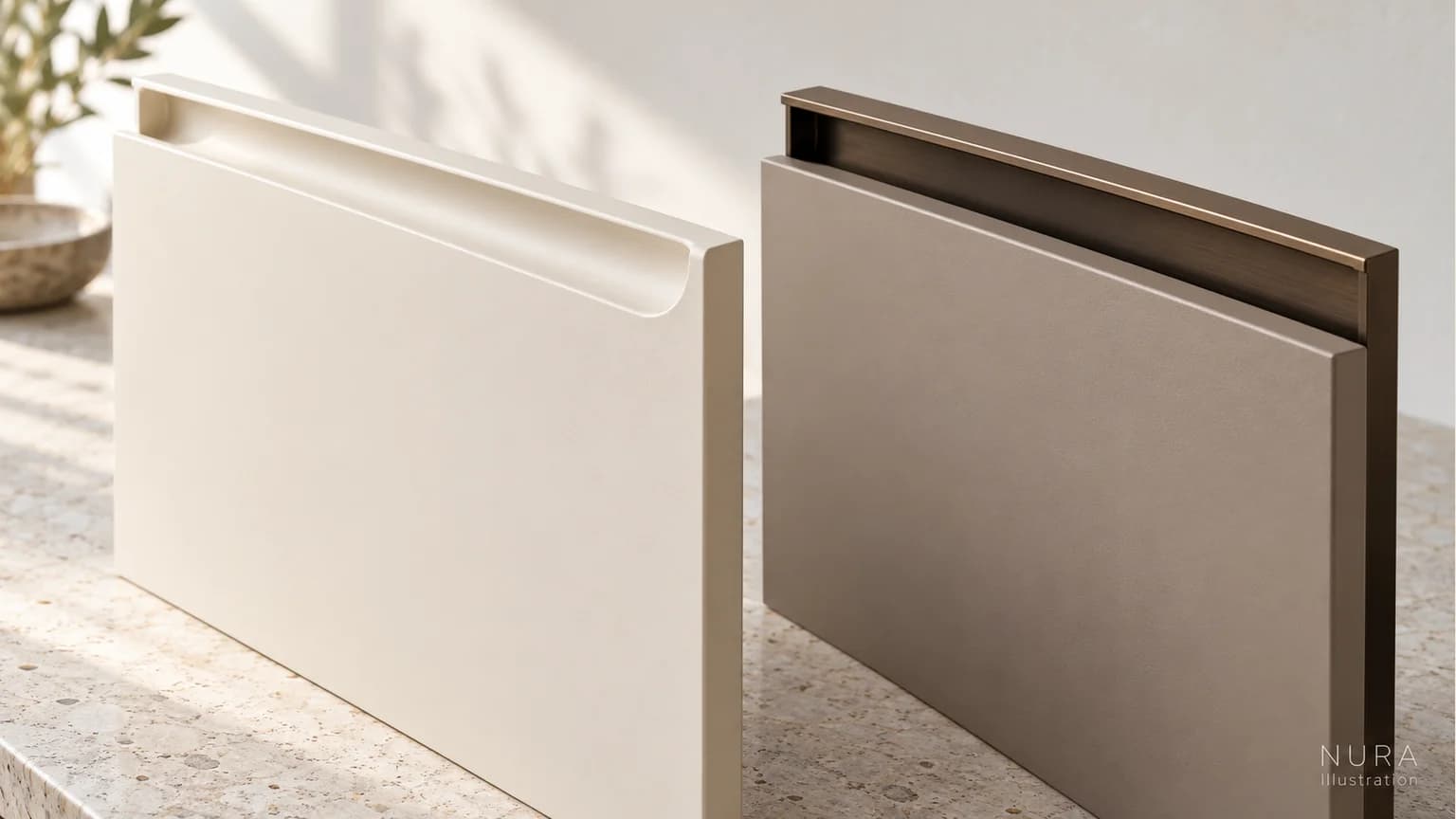
Push-to-open uses a press to activate an opening mechanism. It does not necessarily mean electric: Blum’s TIP-ON for doors is mechanical, opening with a touch and closing when pressed shut. That describes this product, not every push-to-open door, drawer or appliance. Confirm the complete opening and closing specification for each application.
Compare a normal kitchen movement
Ask to try an appropriate working example, where available. Stand where you would use it, open the front, reach into the cupboard or drawer, then close it fully. Note where your fingers go, whether the opening point is easy to find and whether the closing action feels natural. Ask other regular users to make their own comparison. Record the exact front and fitting tried: one waist-height sample cannot represent every low drawer, tall cupboard or appliance.
| Option | Reason to consider it | What to resolve |
|---|---|---|
| J-pull | A pull grip integrated into the front | Whether the shaped edge gives you comfortable finger access |
| Recessed rail | Flat fronts with a separate grip channel | Whether you like the rail lines and can reach each opening point |
| Push-to-open | Opening by pressing the front | Whether both the opening and full closing action suit your routine |
Let the whole kitchen influence the choice
Imagine a household that wants an uninterrupted island facing the dining table, but uses a tall food cupboard repeatedly while cooking. After trying the alternatives, they prefer pulling the tall door and pressing a less frequently used cupboard. That is a hypothetical preference, not a recommendation for every home. Mark those choices on the plan, then compare the full elevation: where would the rail appear, how would drawer lines align, and would any visible handles still be welcome? This gives the designer a specific brief to resolve rather than a general request for “handleless”.
Include the worktop edge, rail finish and adjoining cabinetry in that view. Ask how the proposed finish should be cleaned around the contact points. For integrated fridges and dishwashers, provide the exact appliance models and have the opening arrangement confirmed; a cabinet-door example does not establish appliance compatibility.
Compare contact points and care
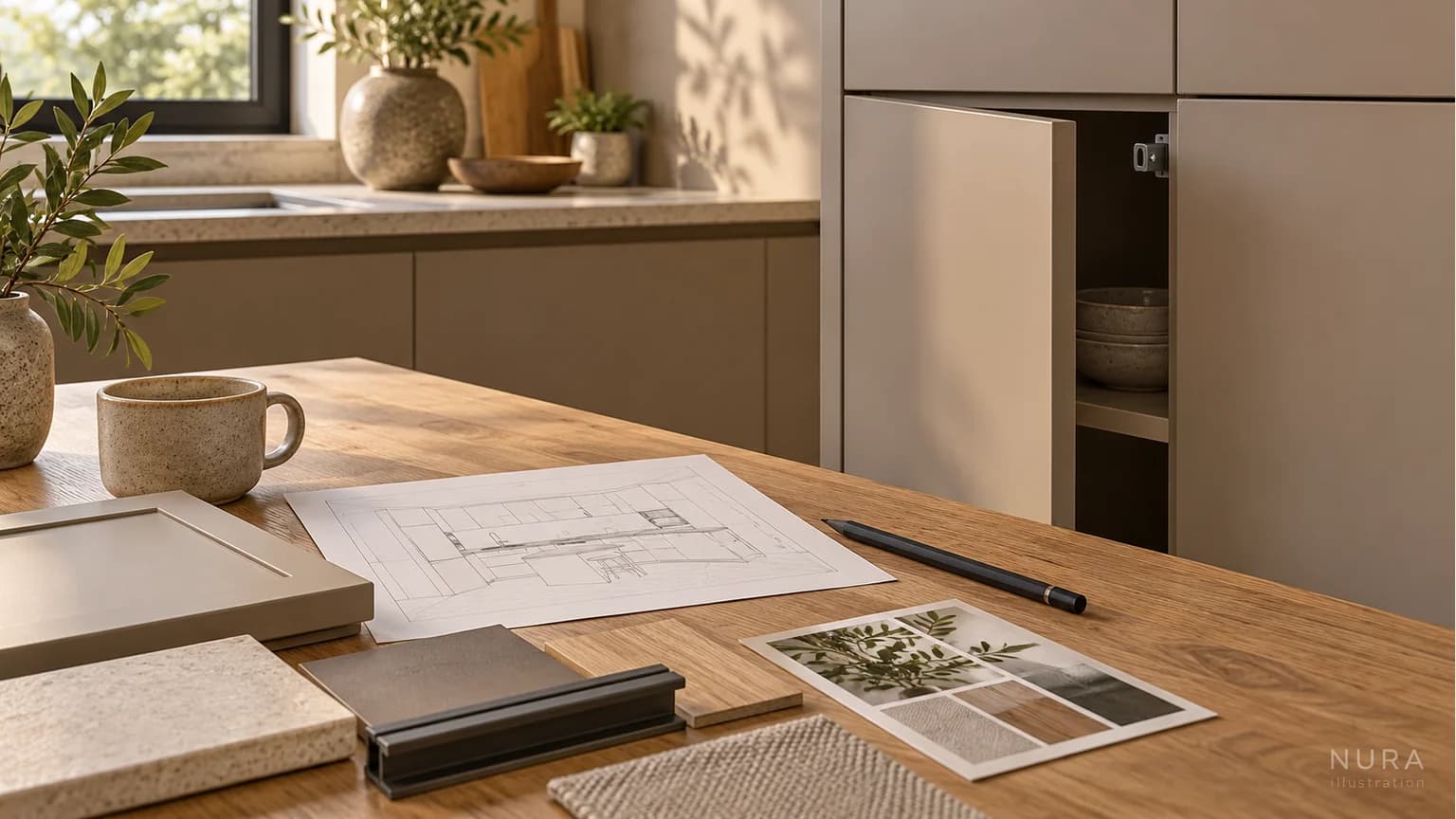
On the samples you are considering, identify the places your fingers touch and the channels you would need to clean. Ask for the care instructions for that exact front and rail finish. A smooth-looking photograph does not tell you how a finish will look after handling, or which cleaner is suitable. Compare a handled alternative too if you prefer a distinct grip away from the door face.
Price the complete proposal, especially for a retrofit
Ask for the doors, rails or opening fittings, installation and any cabinet or appliance changes to be identified in the quotation. Compare proposals for the same units and finishes. A handleless label alone does not establish the final price.
For an existing kitchen, do not assume that removing the handles or changing only the fronts will create the same result as a new rail-based design. Have the existing cabinet construction, hinge arrangement and appliance models assessed before ordering parts. Ask what can remain and what would need to change; keep the answer against the relevant units on your plan.
Bring a brief about use, as well as style
For a Nura kitchen consultation, bring your plan, room photographs, appliance references and a note of the cupboards you use most. Ask which relevant opening systems can be viewed at the Fulham showroom. These inputs help connect your preferred look with the practical bespoke kitchen design. If you are also considering visible hardware, our handle-grip guide provides a useful comparison.