
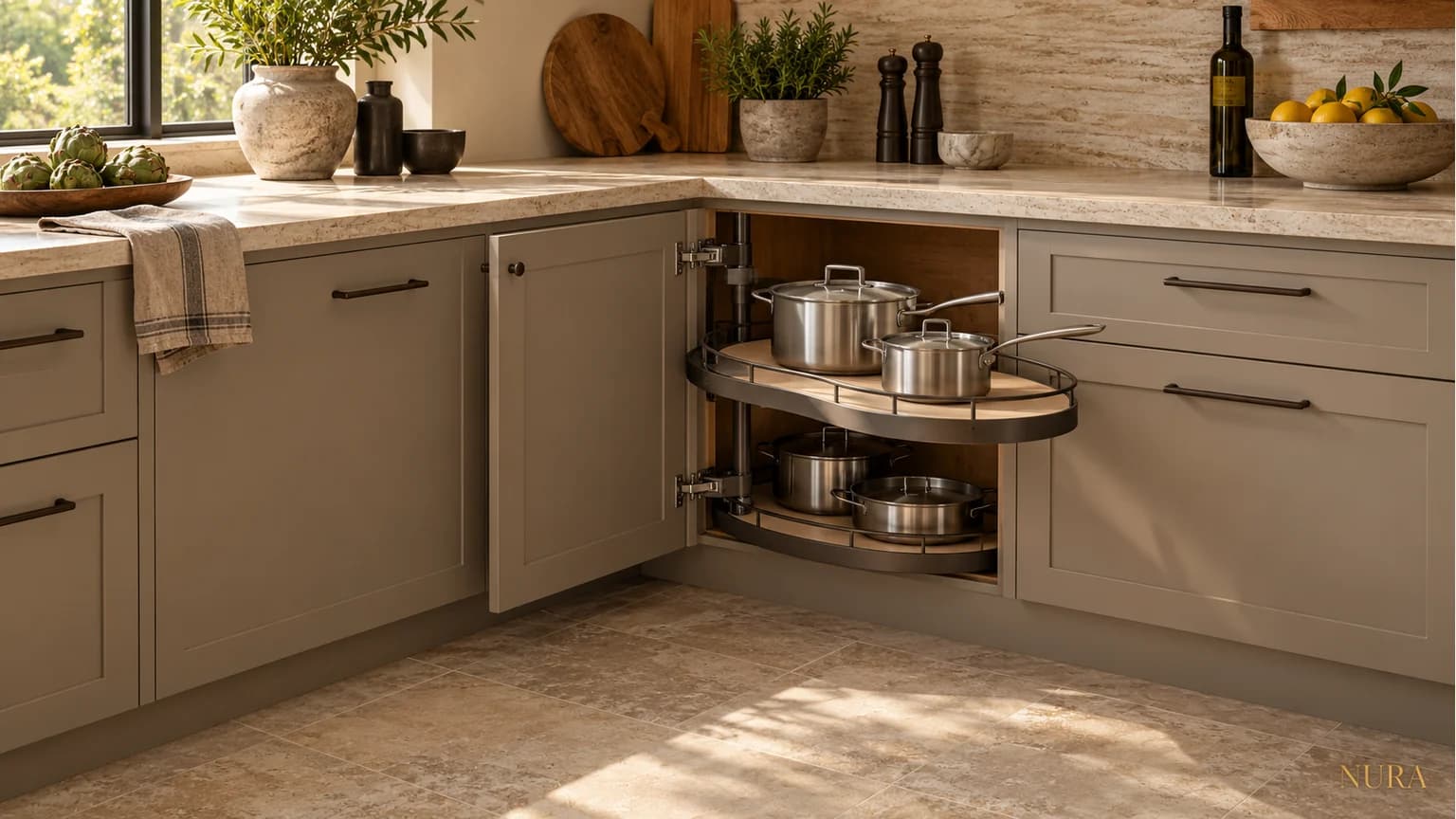

Choose kitchen corner storage by checking what you can put away and retrieve, not just how much space a cabinet appears to contain. Start with your own cookware, compare the opening sequence and ask for the exact fitting requirements. These five checks turn a promising showroom mechanism into a more useful kitchen brief.
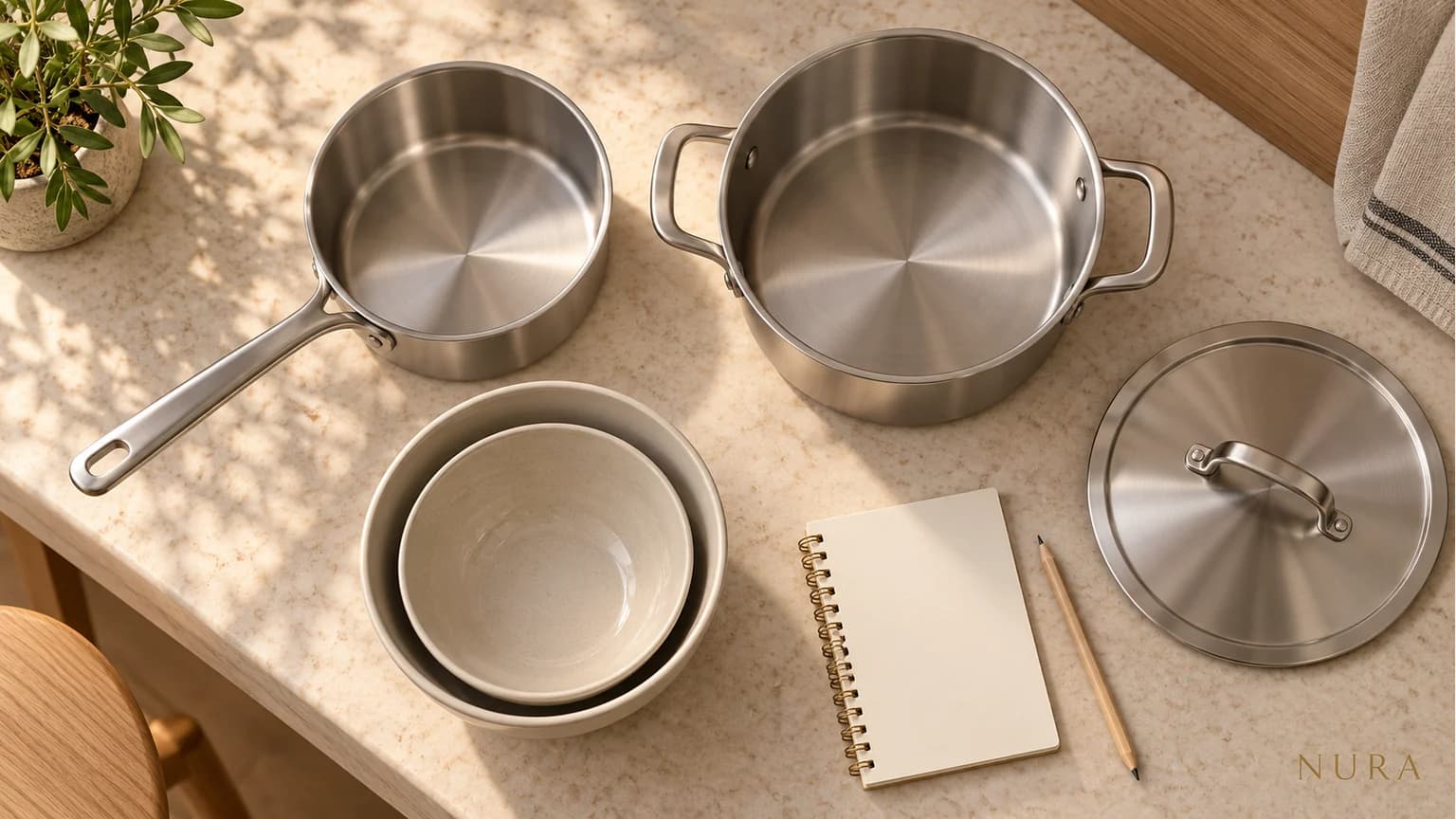
1. List the items, including handles and lids
Set out the empty pots, bowls or small appliances you expect to keep in the corner. Record their overall width, depth and height, including projecting handles. Decide whether lids will stay on, stand separately or share another drawer. Note which pieces you use daily and which come out occasionally. A shelf that holds everything on paper may still be awkward if a frequently used pan sits behind several other objects.
2. Compare access, rather than choosing a universal winner
Ask to see a fixed shelf, a rotating carousel and an appropriate swing-out or pull-out option. A fixed shelf has no moving tray to operate, but the rear still needs to be reachable. A carousel rotates items towards the opening; a swing-out arrangement brings a shelf forward. The useful question is where your actual objects end up and how you lift them out. These categories cover different products, so do not assume every version moves or fits in the same way.
3. Match the exact cabinet and mechanism
Give the designer or fitter the cabinet details and ask for the instructions for the proposed product version. Confirm internal space, door opening, handing, hinge requirements and any services or other obstructions. Cabinet width alone does not establish compatibility. Ask who will verify the proposed fitting before it is ordered; these illustrations are not installation drawings.
For one documented example, Kesseböhmer describes independently moving LeMans shelves. Its download library separates product versions and mounting instructions. Use the instructions for the actual specified product, rather than transferring another model’s dimensions, load rating or opening requirements. This is a product example, not a claim that every corner fitting works alike.
4. Watch the complete opening and return
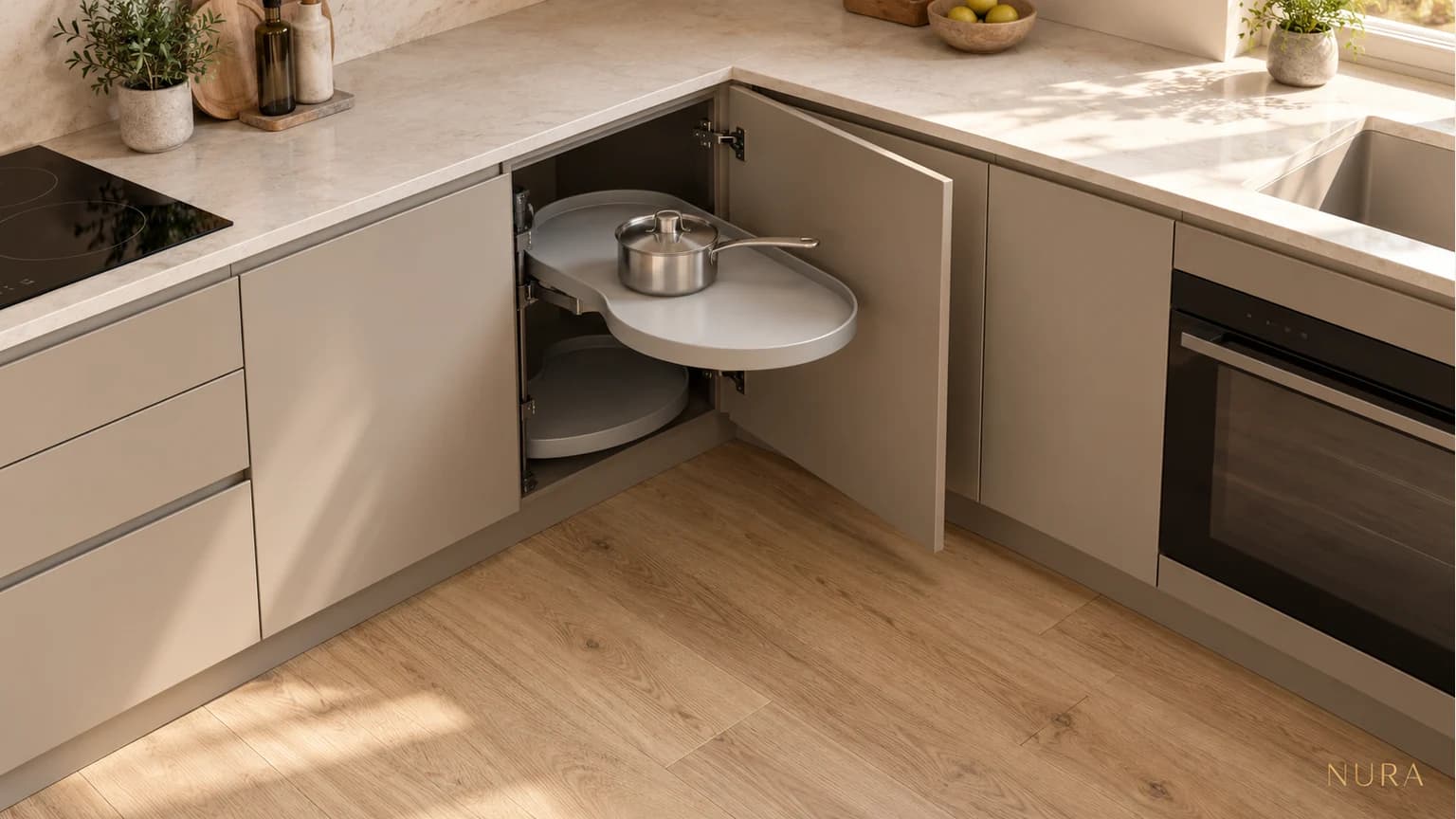
At a suitable display, ask for a demonstration from closed cabinet to full access and back again. Check where the door, tray and your standing position would be in the proposed room. Have the designer assess nearby drawers, appliances and handles against the drawings and applicable instructions. Keep other openings out of the path during the demonstration. Do not force a mechanism, open conflicting doors to test a collision, or alter hinges to make it fit.
5. Try retrieval with representative empty cookware
With the supplier’s permission, use suitable empty cookware to compare the retrieval sequence on the display. Can you see the item, grasp its handles, lift it clear and return it without moving several other pieces? Empty cookware helps compare shape and handling, but does not prove performance under a full load. Confirm the actual product limits and consider where heavier everyday items are most manageable for you.
A small comparison to bring to the design meeting
In a hypothetical kitchen, two nested bowls might fit easily, while a saucepan handle projects across the route to the second shelf. Rather than buying new cookware immediately, compare a different arrangement or keeping that daily pan in a nearby drawer. This is a planning example, not a measured Nura installation.
| Check | Record for this option |
|---|---|
| Fit | Exact product version and cabinet details to confirm |
| Open and return | Door and tray path, nearby fronts and standing position |
| Retrieve | Which everyday item needs other objects moved first |
Connect the corner with the rest of the kitchen
The best place for a particular pan may be elsewhere. Our drawer organisation guide helps you compare that option. For a wider layout brief, explore Nura bespoke kitchens and bring your inventory and the proposed product details to a design consultation. The images here illustrate the questions; they are not photographs of a completed Nura project.