
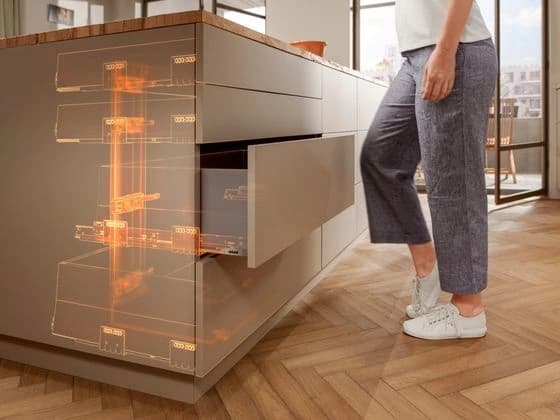

Motorised kitchen storage promises effortless access to high cabinets, deep corner units and tall larders, and in the right context it genuinely delivers. But the decision deserves more scrutiny than a showroom demonstration suggests. Understanding how a mechanism behaves under real loaded conditions, what happens when power is interrupted, and how you will service it years from now is every bit as important as the theatre of a cabinet that opens at a touch.
Function Before Gadgetry
The most useful question to ask about any motorised fitting is not how smoothly it moves in an empty showroom, but how it performs when loaded to the weight you actually intend to carry. Manufacturers publish load ratings for their mechanisms, and those figures matter: a pull-out larder column loaded with tins and bottles behaves very differently from one carrying lightweight packaging. Before specifying any motorised unit, ask your supplier to demonstrate or document the mechanism under a realistic loaded condition, and confirm that the drive motor is rated for that load with appropriate headroom.
Reach and Obstruction Modelling
Motorised lift systems for wall cabinets, sometimes called pocket-door lifts or flap fittings, open upward or fold away rather than swinging outward. This is genuinely useful in tight kitchens, but the travel arc still needs to be modelled against your specific ceiling height, any pelmet or cornice detail, and adjacent appliances. A hypothetical scenario: if a cabinet sits directly beneath a low ceiling coffer, the flap may not reach its fully open position, leaving the mechanism straining against an obstruction. Your designer should produce a dimensioned elevation showing the full travel path before the cabinet is ordered.
Power Failure and Manual Override
This is the question most often skipped in the excitement of specification, and it is the one that matters most on a Sunday evening when the electricity trips. Some motorised mechanisms include a manual override, a release point or a key slot that allows the door or drawer to be opened by hand. Others do not. Whether a manual override exists, and how accessible it is, depends entirely on the specific model you choose. Ask the manufacturer or supplier directly, and get the answer in writing. Do not assume that all motorised fittings share this feature.
Choosing Between Hardware Families
Choose the exact product before comparing brands. A motorised drawer, a lifting mechanism and an electrically assisted cupboard opening may have different requirements and servicing arrangements. Nura can discuss Blum and HiGold options where relevant, but that does not establish that products from different systems can be combined. Ask for the model reference, its supported application, the appropriate documentation and the supplier’s service contact. Confirm warranty and spare-parts arrangements for the region where the kitchen will be installed.
Other hardware families worth considering include Grass, Hettich, Salice, Sugatsune, King Slide, Häfele, Vauth-Sagel, Kesseböhmer, Clip (by Clip Systems), Rev-A-Shelf, Richelieu, Accuride, and Fulterer, fourteen distinct brands, each with their own load ratings, drive technologies, and service models. Hinge mechanisms alone span a wide range: concealed cup hinges, integrated damped hinges, pivot hinges, and soft-close variants number well over thirty distinct types across these families. Matching the right hinge to a motorised door panel is a detail your joiner or cabinet-maker should resolve at the drawing stage, not on site.
Service Access and Parts
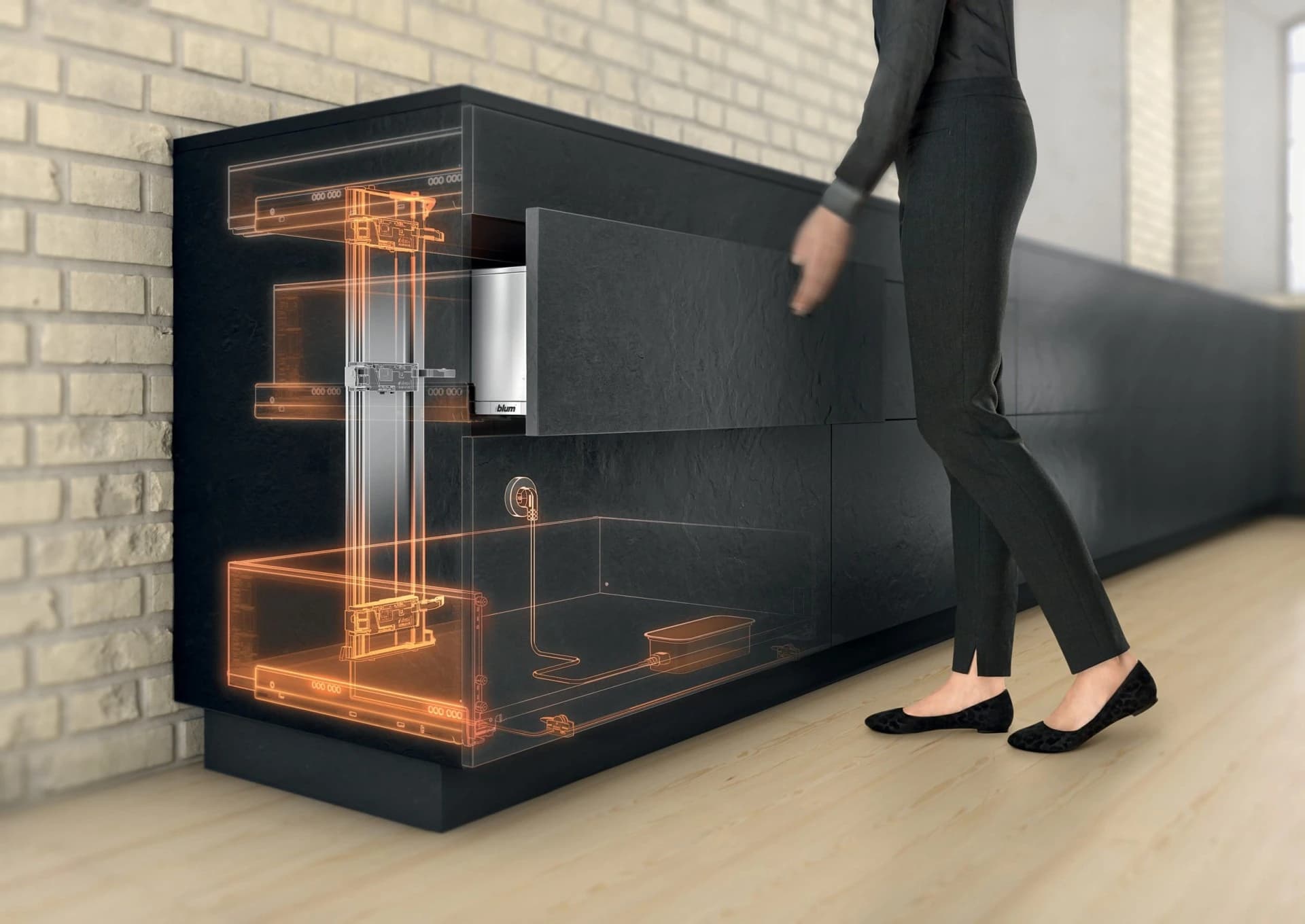
Motorised fittings contain drive motors, control boards, wiring looms, and in some cases Bluetooth or app-based control modules. All of these components can fail, and all of them need to be reachable when they do. When planning the cabinet carcass, confirm with your maker that the motor housing and wiring connections are accessible without dismantling the entire unit. Ask the supplier how long replacement parts are committed to be stocked, and whether a local engineer can service the mechanism or whether it must be returned to the manufacturer. These are reasonable questions; a reputable supplier will answer them clearly.
Electrical Planning and Integration
Ask the installer to identify the electrical requirements of each selected mechanism and coordinate them with the electrician. The position of any power supply, cabling and controls should follow that product’s instructions and remain accessible as required. Do not assume that every motorised fitting uses the same voltage, connection or control arrangement. Showing these components on the cabinet and service drawings helps the team identify conflicts before manufacture and avoids treating a general hardware description as an installation specification.
Maintenance Expectations
Ask which maintenance checks, cleaning and servicing the selected system requires, and keep its instructions with the kitchen records. If a mechanism begins to hesitate or behave differently, follow the stated troubleshooting route rather than improvising an adjustment. Confirm who can assess the issue and how a replacement part would be obtained. Where a manual opening or power-failure arrangement exists, ask the installer to demonstrate it for that model; do not assume the same behaviour across all electronic storage products.
Working With Your Designer
Motorised storage works best when it is designed in from the outset rather than added to a standard cabinet layout. The carcass depth, internal shelf positions, and door weight all influence which mechanism is appropriate. If you are working with an architect or interior designer, sharing the hardware shortlist early avoids costly revisions later, a point worth raising at the professional collaboration stage of any project. The goal is a kitchen where the technology serves the cooking, not the other way around.
If you would like to discuss how motorised storage might work within a bespoke kitchen layout, book an initial consultation and bring your wish list, we will work through the practical implications together.
Planning your next step
Use this guide as a starting point for your own brief. Compare the room, materials and practical requirements with the way you want the space to work.
Read the bespoke kitchen planning guide or explore Nura bespoke kitchen services before discussing your project.
Ready to discuss the brief? Contact the Nura studio to share your plans, questions and priorities.