
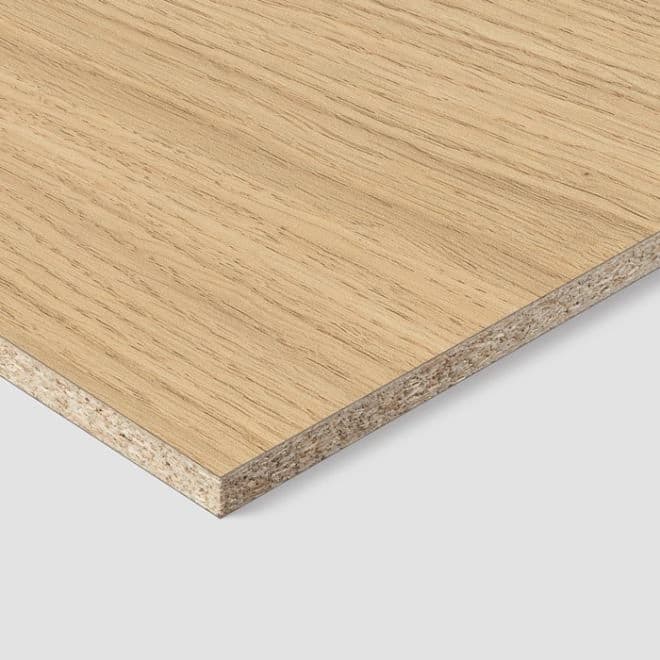

Both plywood and MFC can make suitable kitchen carcasses. MFC offers a factory-finished decorative face; plywood may suit a specified veneer finish or visible layered-edge design. Choose by the actual board grade, cabinet construction, moisture detailing and total finished cost, rather than the material name alone.
A carcass is the cabinet box behind the doors: its sides, base, back, top or rails, and shelves. When comparing kitchen quotes, assess that complete assembly. This guide gives you a comparison table, a hypothetical sink-cabinet example and questions to put to each supplier.
What Is MFC?
Melamine-faced chipboard is a particleboard core, wood particles bonded under heat and pressure, with a melamine resin surface laminated to both faces. The melamine layer provides the finished appearance and a degree of surface protection, but the core itself is particleboard, not MDF and not inherently moisture resistant.
Particleboard for furniture and cabinetry is classified under EN 312. Standard interior-grade board is P2, suitable for use in dry conditions. P3 is a moisture-resistant particleboard grade for humid conditions; the P2/P3 distinction does not apply to plywood. “Non-load-bearing” in a board classification concerns its structural use, rather than saying a finished cabinet shelf cannot carry contents. The cabinet designer still needs to select the board and support arrangement for the intended load. According to Egger's technical support documentation, standard P2 Eurodekor-faced chipboard is distinct from moisture-resistant P3 board, which is specifically recommended for humid environments. When specifying MFC for kitchen carcasses, confirming whether the board is P2 or P3 is a practical and important question, not a minor detail.
The exposed core at cut edges, drill holes, and cabinet cutouts is the material's most vulnerable point. Unsealed edges absorb moisture readily. The quality of edging, whether PVC, ABS, or a matching melamine strip, and the adhesive used to apply it significantly affects how long that protection holds. Inspect the sample's edge joints and ask how the supplier treats site-cut openings; edging thickness alone does not establish durability.
What Is Plywood?
Plywood is a panel product built from thin wood veneers, with adjacent layers commonly arranged at right angles. The APA - The Engineered Wood Association defines it as an engineered wood panel made from these cross-laminated veneer layers, a construction that distributes stress across the panel and resists warping.
The performance of any given plywood sheet depends on several variables: the species used in the face and core veneers, the number of plies, the presence and size of voids in the core, the thickness, and the adhesive bond classification. The adhesive bond classification describes bond durability; it is not a complete assessment of the finished panel. Check the manufacturer’s declared intended service conditions alongside the face, core and finish. A bond designation alone does not make a cabinet waterproof. A kitchen joiner using "hardwood plywood" may be using a product with a decorative face veneer over a mixed or lower-grade core. Asking specifically about bond class, core quality, and intended service classification gives you a more accurate picture than the word "plywood" alone.
Face appearance is a separate question from bond performance. Ask for the named product, declared grade, thickness and relevant data sheet. Core gaps or local defects can affect a fixing position; their significance depends on the product and joint. Neither an 18mm label nor the term “marine” establishes the performance of a finished cabinet.
Which Material Suits Your Kitchen Brief?
For a consistent decorative interior
compare factory-faced MFC with a plywood option finished to the same standard. Ask to see a finished sample, including an internal corner and an edge, rather than a bare board swatch.
For visible layered edges
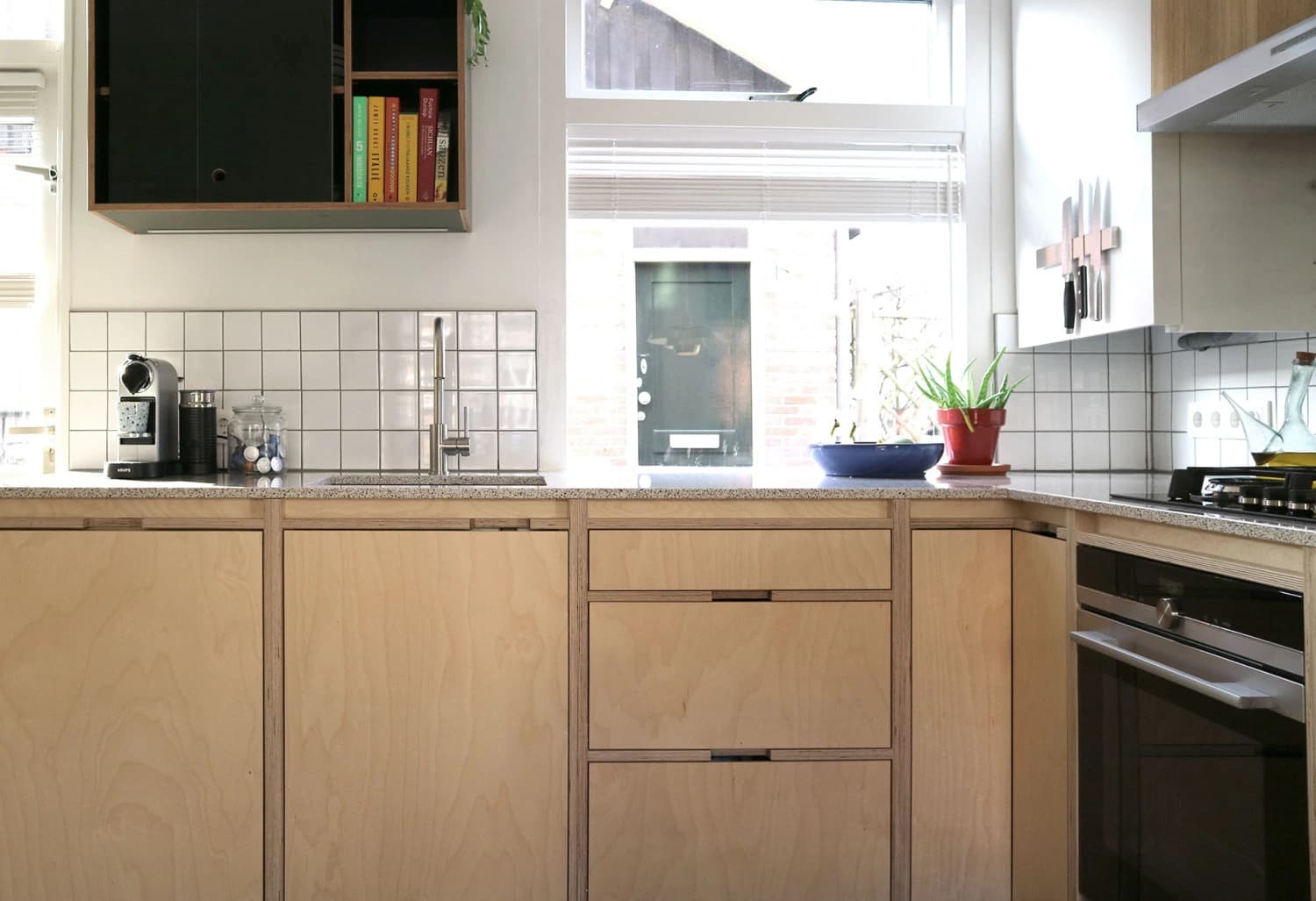
plywood can make the edge part of the design. Agree the veneer appearance, permitted repairs and edge finish in a sample; an attractive face alone does not establish the quality of the core.
For sink and dishwasher areas
choose a documented board and cabinet detail suitable for the location. A moisture-resistant grade is useful information, but it does not prevent a plumbing leak. Check access for inspecting pipes, protection of site-cut openings and the appliance manufacturer's requirements.
For wide shelves or heavy storage
ask for the proposed clear span, support positions and intended load. A board name or thickness is not a shelf-capacity calculation. Compare the assembled design before paying for a material change.
Side-by-Side Comparison
| Property | Plywood | MFC (Melamine-Faced Chipboard) |
|---|---|---|
| Core material | Cross-laminated wood veneers; species and void content vary by grade | Particleboard (wood particles and resin); density and quality vary by manufacturer |
| Surface finish | Typically veneered, painted, or laminated post-manufacture | Factory-applied melamine laminate; colour and texture consistent |
| Moisture performance | Depends on bond class and veneer quality; not universally waterproof | P2 for dry conditions; P3 for humid environments; exposed edges require sealing |
| Structural characteristics | Stiffness depends on species, lay-up, thickness, span and support | Shelf and cabinet performance depend on the board grade, dimensions, support and joints |
| Fixings and hardware | Specify hardware and fixing positions suitable for the exact plywood product | Specify suitable connectors, pilot holes and edge distances for the exact particleboard product |
| Finished cost implications | Material cost typically higher; finishing and labour may add further cost depending on specification | Material cost typically lower; finishing largely complete at panel stage; edging is an additional labour step |
All comparisons are qualitative. Actual performance depends on the specific grade, manufacturer, installation method, and environment.
Where the Details Decide the Outcome
The Sink Cabinet Illustration
Consider, hypothetically, two 600mm base units beneath a kitchen sink, one built from each material, both with 18mm sides. Ask both suppliers for the same external dimensions, usable internal space, back arrangement and hardware. For plywood, check the product's intended service conditions and surface treatment. For MFC, identify the particleboard grade. For both, request details of exposed edges, plumbing openings and appliance clearances. Then compare the completed scope, including who protects any cuts made on site. This is a specification exercise, not a tested cabinet or a load-capacity claim. Neither cabinet is automatically the better choice. Both can fail if the specification or installation is wrong.
Edging, Cutouts, and Appliance Openings
Every saw cut in MFC exposes raw particleboard. Appliance housing cutouts, pipe penetrations, and shelf pin holes are all potential entry points for moisture. Poor bonding can leave gaps or allow edging to detach. Follow the board and edging supplier’s processing guidance and the appliance manufacturer’s ventilation and protection requirements. Do not assume a thicker edge compensates for poor application. EGGER’s Eurodekor processing instructions provide product-specific guidance; they do not certify an assembled cabinet.
Backs, Joints, and Shelf Geometry
The back panel and its attachment help resist racking: the tendency of a rectangular cabinet to move out of square. A recessed back can also be a substantial panel; its position and thickness are separate details. Joints between carcass components, the method used to fix the back, and whether shelf supports are correctly positioned for the load geometry all influence how a cabinet performs over years of use. These factors apply equally to both materials.
Compare the Finished Cost, Not Just the Board Price
Ask for the same cabinet schedule and scope before comparing totals. Include the board, decorative facing or coating, edge treatment, machining, back panels, hardware, delivery, fitting and VAT. Identify exclusions and allowances separately. A factory-faced panel and an unfinished plywood panel are not equivalent finished products.
An upgrade is useful when the supplier can explain what changes and why it suits your project. Ask for an itemised alternative rather than assuming a price premium proves longer life. Neither a current market price nor a service-life estimate can be established from the words “MFC” and “plywood” alone.
A Better Specification: What the Quote Should Actually Say
“18mm plywood carcasses” or “premium MFC cabinets” leaves important decisions unstated. Request a product name and grade, thicknesses for each component, the interior face finish, edge treatment, back construction and fixing method. Ask the supplier to identify where its standard detail changes around water or appliances.
For example, a useful specification records the side/base board product and thickness; shelf dimensions and support; back material, thickness and attachment; face finish; exposed-edge treatment; connectors and hardware; and who finishes site-cut openings. These are information fields to complete, not a claim about a particular Nura cabinet.
Open the printable carcass comparison worksheet to collect the same information from two suppliers. Mark missing answers as “not specified” rather than assuming the more expensive quotation includes them.
Six Questions to Ask Your Kitchen Supplier
- For MFC, is the particleboard P2 or P3, and is that appropriate for each cabinet location in my kitchen?
- What bond class is the plywood, and what service environment is it rated for?
- How are cut edges and appliance cutouts sealed or edged, and what adhesive is used?
- How is the cabinet back fixed, and does it contribute to the structural rigidity of the carcass?
- What thickness is specified for base sides, wall unit sides, and shelves respectively?
- Can you provide an itemised cost showing material, edging, hardware, and installation separately?
Frequently Asked Questions
Is MFC always inferior to plywood in kitchens?
No. Correctly specified P3 MFC with properly sealed edges and appropriate fixings performs well in kitchen environments. The comparison depends on specification, not material category alone.
Does plywood mean the cabinet is waterproof?
No. Check the named plywood product and its intended service conditions. A marine designation does not turn the assembled cabinet into a waterproof unit; faces, edges, openings and joints still need appropriate detailing.
Why does edging quality matter so much for MFC?
The particleboard core is the material's most moisture-sensitive point. The specified edging or sealing system helps protect exposed cuts. Its suitability depends on the complete system and application, rather than thickness alone. Moisture-resistant board still needs appropriate detailing and care.
Can I compare quotes that use different materials?
Yes, but you need itemised breakdowns. A quote using P3 MFC with ABS edging and a quote using plywood with a painted finish involve different material costs, labour steps, and long-term performance profiles. Comparing totals without understanding what is included is not a reliable basis for decision-making. This guide to comparing bespoke kitchen quotes explains what to look for line by line.
Making the Decision
Neither plywood nor MFC is the universally correct answer. The right choice depends on your specific cabinet locations, the moisture conditions in your kitchen, the quality of the product being sourced, and the care taken during installation. Neither material name establishes a service life. The questions above will tell you more than the material name alone.
If you would like to discuss carcass specification as part of a broader kitchen design conversation, book a consultation with Nura Interiors.
Planning your next step
Use this guide as a starting point for your own brief. Compare the room, materials and practical requirements with the way you want the space to work.
Read the bespoke kitchen planning guide or explore Nura bespoke kitchen services before discussing your project.
Ready to discuss the brief? Contact the Nura studio to share your plans, questions and priorities.