
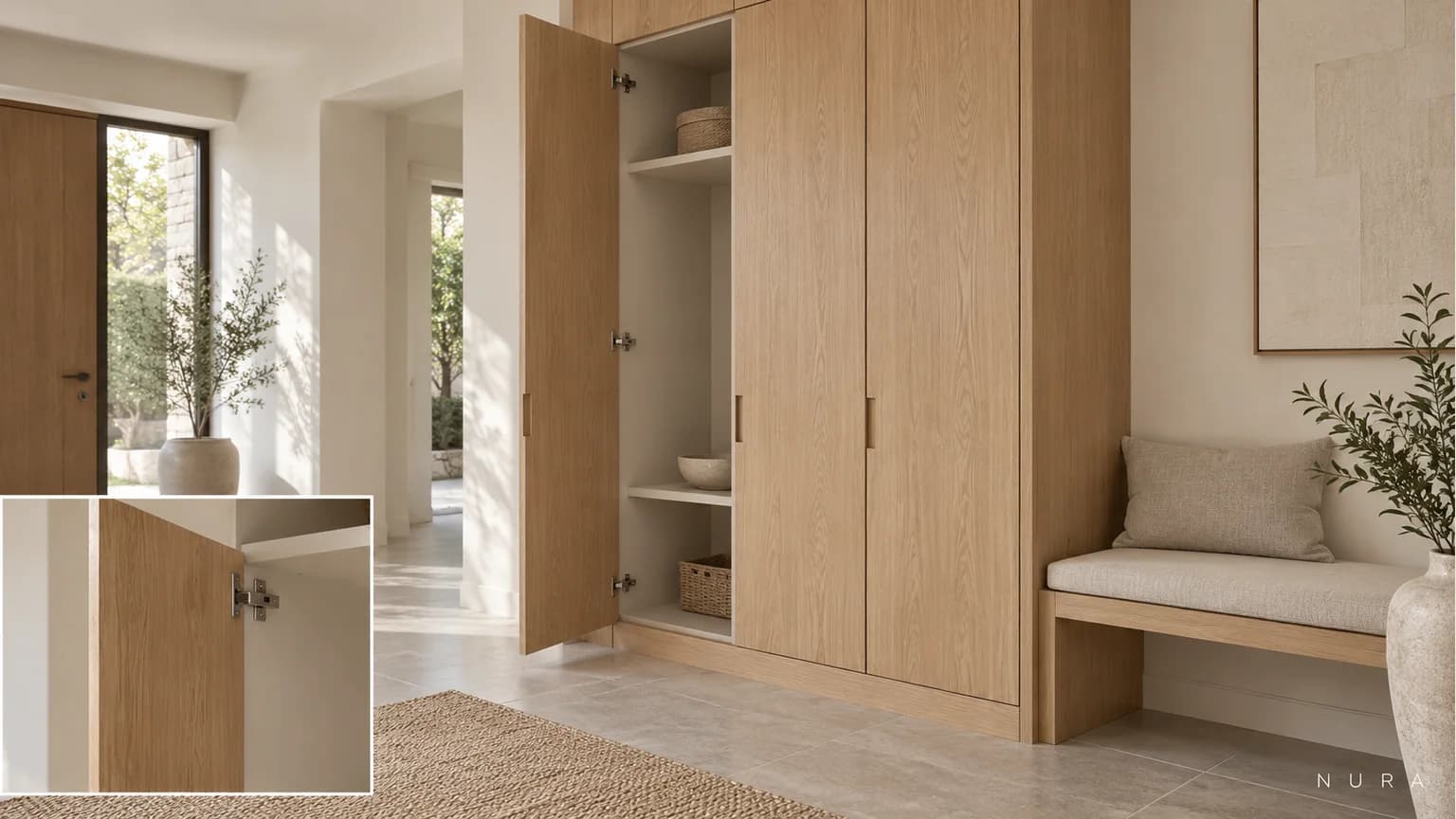

A joinery snagging and handover record should connect each observation to a particular cabinet, the information it is being reviewed against and the next agreed action. Keep an unanswered design question, a reported repair and a checked outcome distinguishable. A photograph marked “done” cannot explain which of those has happened.
For architects, interior designers and clients reviewing fitted furniture, the useful outcome is a record the project team can follow after the walk-through. Pair it with relevant product and care information, rather than treating the snag list as the whole handover pack.
Locate the component and the reference
Start with the room, furniture item and particular part: “hall unit J08, right-hand door, lower outside corner” is more useful than “hall joinery”. Use the same item reference as the current drawings or joinery schedule, alongside a plain-language location.
Take a context photograph to locate the part and a closer view to show the observation. Date the record and identify the drawing issue, finish reference or other agreed information relevant to the question. Record what you can see without guessing its cause. If a surface is still protected or a cupboard cannot be accessed, say what has not been reviewed.
Keep observations that need different responses separately traceable. A concern about a door finish and a missing care sheet may involve the same unit, but receiving a document does not resolve the finish question.
Separate the observation from the decision
An apparent difference needs a clear comparison basis. Ask which surface the accepted sample represents, whether the current drawing records that choice and whether a later change was agreed. Our samples and mock-ups guide explains why accepting one finish or detail does not approve every part of the furniture.
Record an unresolved selection as a decision requiring a response, rather than quietly treating it as either an accepted finish or an agreed repair. Likewise, do not turn a newly requested feature into unfinished work without checking the agreed scope. The appointed project team should establish the appropriate response and authority for the actual appointment.
Describe concerns about normal operation without prescribing an adjustment. Do not force a component, remove hardware or carry out specialist testing to complete a list. Ask the relevant installer or specialist to assess anything outside the agreed review scope.
Follow one hall unit through close-out
Consider a hypothetical hall cabinet, J08. A small surface mark is visible at the lower outside corner of its right-hand door. Separately, the client asks whether its internal finish should match the outside. Sample F12 was accepted for the exterior doors, but the available record does not settle the interior finish. The client also needs care information for the installed surfaces.
Avoid a single entry saying “finish wrong, rectify”. A useful record separates the questions:
| Record | Next response to request | Evidence to retain |
|---|---|---|
| J08 right-hand door, lower outside corner: visible surface mark | Joinery contractor to assess the marked area and confirm the proposed response, without assuming the cause or repair | Dated context and close views, relevant finish reference and the agreed response |
| J08 interior finish question, with dated location photographs | Design lead to identify the agreed interior selection or record the decision still required | Relevant drawing issue, sample scope and dated response |
| J08 installed finish identification and care information missing from the pack | Supplier to identify the installed product and provide applicable care guidance | Product or finish reference linked to J08 and the received document |
| Any action subsequently agreed for J08 | Record the action, responsible contact, access needs and agreed review arrangement | Completion report and a separate dated review of that action |
These are discussion records, not findings from a Nura project. The first response might clarify an existing agreement or reveal a decision still needed. It does not automatically establish a defect, a change instruction or permission to alter the cabinet.
Make closure a separate event
When someone reports an action complete, preserve that report and arrange the relevant review. State what was checked, by whom, when and against which original observation or agreed action. Keep the earlier photographs and add dated follow-up evidence where useful.
If the requested care sheet arrives, that document item can be recorded as received while the finish decision remains open. For the surface mark, a contractor's completion report should be followed by the agreed review of that same corner. Record what is visible and any remaining concern, rather than assuming that a report of completion proves acceptance. If an agreed physical action is reviewed, describe its actual outcome instead of replacing the original entry with “all satisfactory”. Record remaining access restrictions or questions explicitly. A closed action should not silently close unrelated concerns on the same cabinet.
Assemble information for everyday use
Alongside the open-action record, ask for the information applicable to the installed joinery: identified finishes and where they occur, relevant hardware or product references, supplied operation and care guidance, and the agreed contact for later queries. Ask which drawings or other records describe the completed scope, particularly where agreed changes occurred.
Confirm what is available, what is still requested and who will supply it. Do not substitute a generic cleaning recommendation for guidance appropriate to the actual finish. Where separate suppliers are involved, keep their contacts and scope identifiable, as discussed in our whole-home supplier comparison.
For a forthcoming architectural joinery project, bring drawings, finish references and an example of the handover information you need. Discuss the scope with Nura, including installation, completion review, care information and follow-up responsibilities for the proposed appointment.