
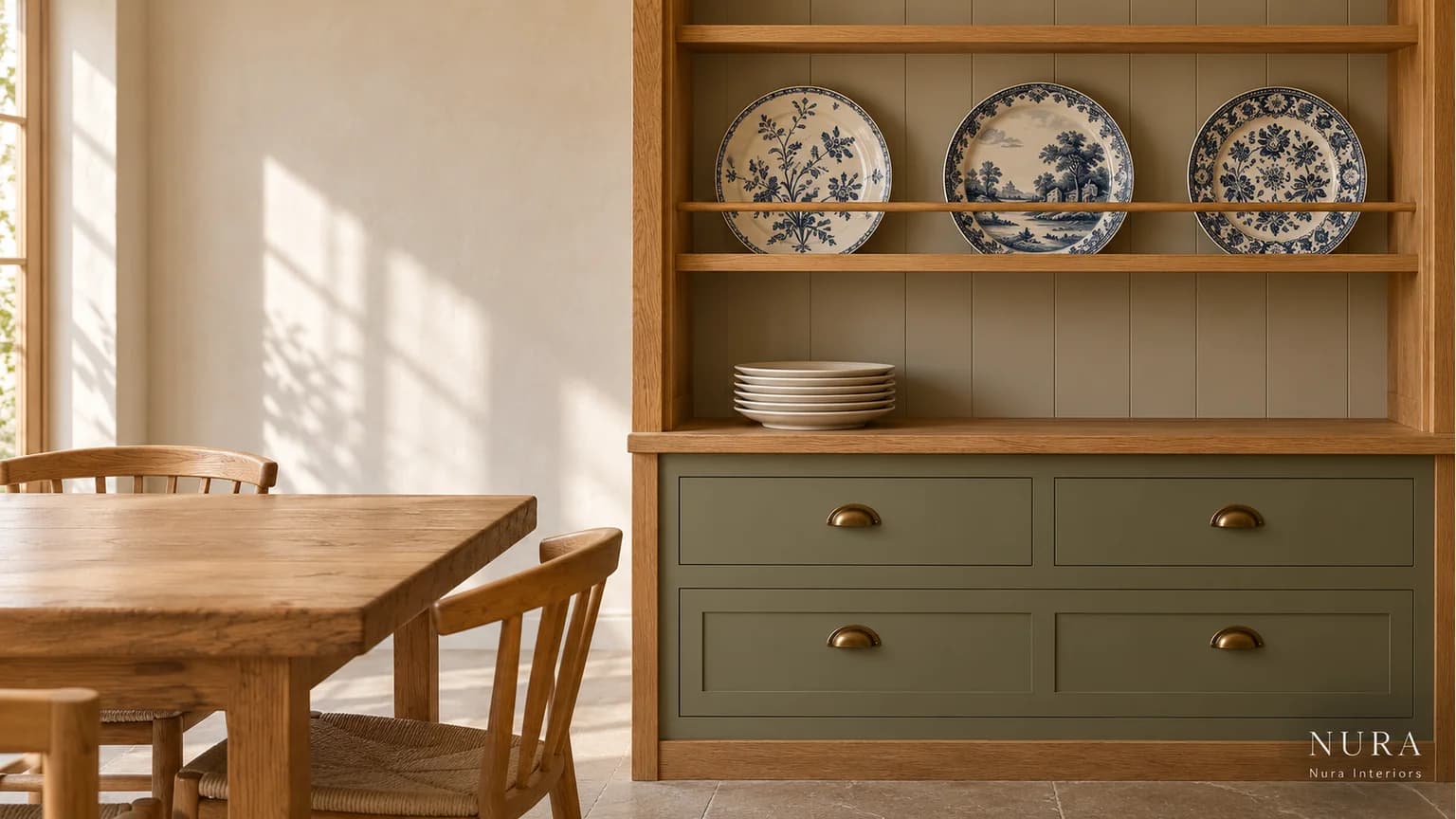

Kitchen plate display ideas work better when you decide which plates need to come down at mealtimes. Keep frequently used crockery easy to retrieve; give favourite decorative pieces a setting that does not depend on those everyday plates staying in place. Start with what you own before choosing a rack, shelf or wall arrangement.
Sort by use, then choose the display
Put your plates into three groups: used at most meals, brought out occasionally, and kept mainly for display. Record the quantity and largest diameter in each group. A serving platter can be both useful and decorative, but it still needs a way out of its display without moving half the collection.
| What you own | Try this arrangement | Check before committing |
|---|---|---|
| Everyday dinner plates | An accessible stack or a rack intended for regular use | Can you take the required plates out without shifting ornaments? |
| An occasional serving platter | A visible position with its own clear removal route | Does it fit the proposed shelf or holder, including its depth? |
| Favourite decorative plates | A separate display group | Does the arrangement still look intentional when daily crockery is elsewhere? |
Judge the backdrop with plates missing
Photograph the proposed area with the adjacent cabinetry and dining furniture visible. On a copy, sketch the rack outline and plate circles to the same chosen scale. For a full-size mock-up, use paper templates on the wall where suitable for its finish. Neither exercise verifies a fixing or load capacity.
Then cover or remove the everyday-plate shapes from the sketch. This is the view you will have while the table is laid. If the display loses its focal point, reserve that position for a piece you rarely use, or let an everyday stack belong to a different part of the cabinet.
Try a restrained group against both the wall colour and the cabinet finish. Blue rims might repeat a colour elsewhere in the room; plain cream plates might be easier to distinguish against a darker backing. Matching is an option, not a requirement. Compare the view from the dining chair as well as from directly in front.
Turn the idea into a cabinet brief
For a hypothetical household with six daily plates and two decorative platters, the useful choice may be accessible daily storage beside a smaller display of the platters. Buying a larger rack would answer a different need. Consider the space alongside your shelf styling and drawer or cupboard choices.
Before installation, ask the supplier or fitter to confirm the holder, plate retention, load capacity and fixings for the actual plates and supporting surface. A photograph cannot establish these details.
Bring the plate inventory, diameters and marked-up room photograph to a Nura consultation to discuss display alongside your cabinetry and storage brief. Ask which relevant examples are available. Explore our bespoke kitchen service and the documented Elm Park Road kitchen for the wider room context.