
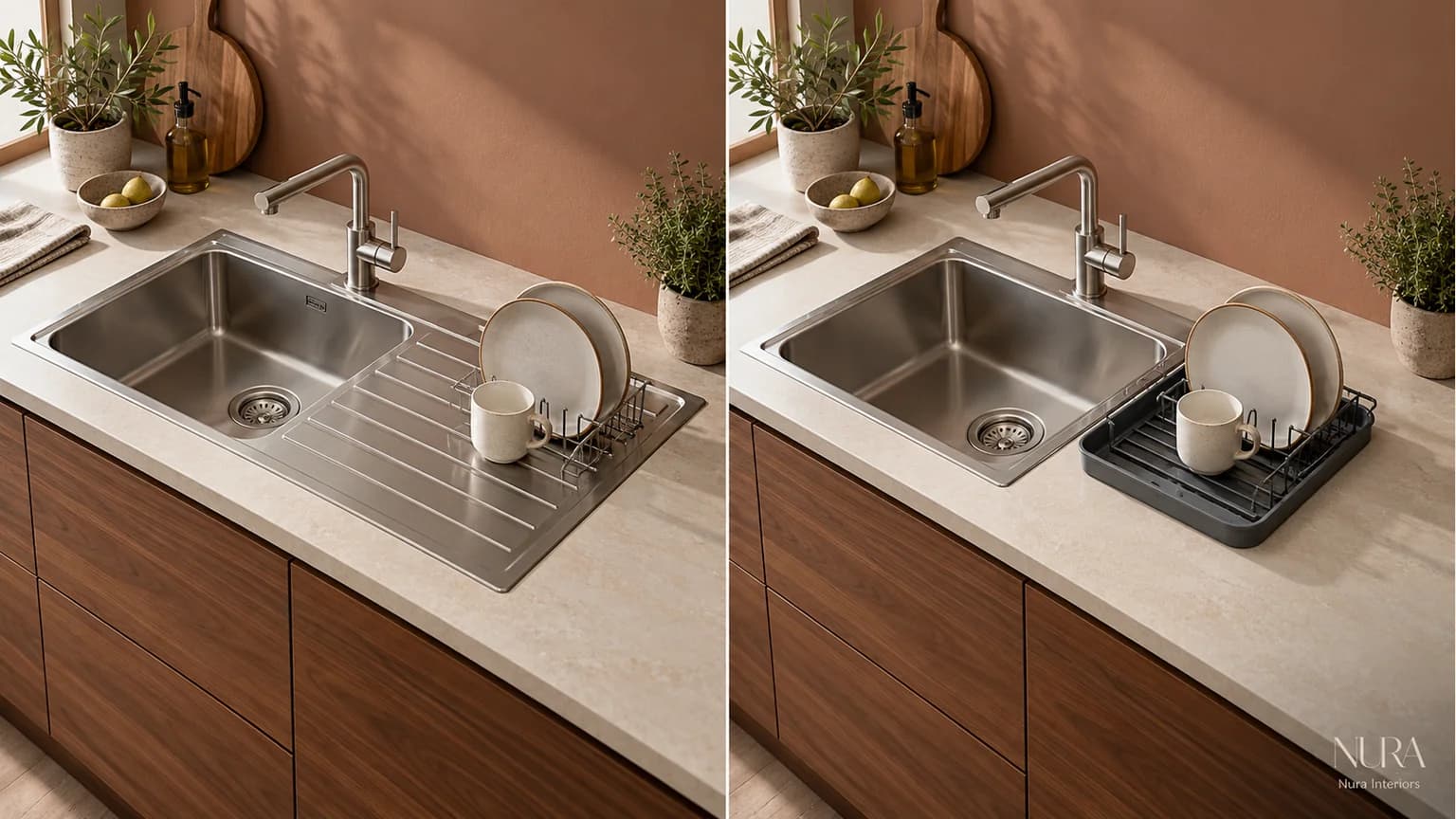

A kitchen sink with a fixed drainer reserves a drying surface beside the bowl. A sink without one leaves you to choose another drying arrangement. Neither choice removes the need to plan where hand-washed items go. Compare the area while dishes are drying, after they are put away, and with any removable rack stored.
Start with what stays out of the dishwasher
List the items you actually wash by hand, following their makers' care instructions. A few mugs need a different arrangement from a large pan, serving platter and several containers. Note whether these items wait to dry while someone prepares the next meal. Having a dishwasher does not answer that question by itself.
For a hypothetical weeknight, most plates go into the dishwasher but a pan and a wooden board remain. If they stay beside the sink through breakfast preparation, a removable tray still occupies that counter during breakfast. Its empty appearance in a product photograph does not establish how much preparation space your household will have.
Compare three drying arrangements
An integral draining board stays part of the sink when it is empty. A removable counter tray can reveal worktop when it is moved, but needs a suitable place to go. An over-bowl rack uses space above the bowl instead. Compare the complete arrangement, including any rack needed to support your dishes, rather than treating every draining surface as interchangeable.
| Arrangement | While dishes are drying | When cleared |
|---|---|---|
| Integral draining board | The fixed surface beside the bowl is occupied | The draining board remains in the sink's footprint |
| Removable counter tray | The tray and dishes occupy adjacent worktop | Worktop is available after the tray is cleaned, dried and stored as instructed |
| Compatible over-bowl rack | The rack covers part of the bowl opening | The opening is available after removal, with storage still needed for the rack |
Use the size of your current drying arrangement as a starting point for a plan sketch. Add the pan or platter that makes the arrangement difficult, then show your usual chopping board nearby. A paper outline helps compare occupied areas; it cannot prove accessory fit, support or drainage.
Check the model, the side and the water path
Franke's UK sink selection guide distinguishes sinks that need a particular left- or right-hand drainer version from reversible models. It also asks buyers to check the specified cabinet width. Confirm those details for the exact sink, alongside its worktop and installation requirements.
For a separate tray, establish whether it collects water for emptying or directs it into the sink, and how it is cleaned. For an over-bowl accessory, check the maker's compatibility, support and use instructions. If you are considering grooves or a recessed area in the worktop, ask the fabricator whether the proposed detail is suitable for that specific surface and how it will work. Do not assume that a groove or a loose rack provides a complete drying arrangement.
Bring both views to the kitchen discussion
Photograph the sink area in use and cleared. Bring the hand-washed item list, proposed sink and accessory details, and a sketch showing the drying area beside your preparation space. Record where a removable tray or rack would be stored. These inputs make the appearance and daily-use trade-off specific.
If bowl configuration is still undecided, compare single and double kitchen sinks separately. Explore Nura bespoke kitchens, then discuss your sink area and kitchen brief with the studio.