
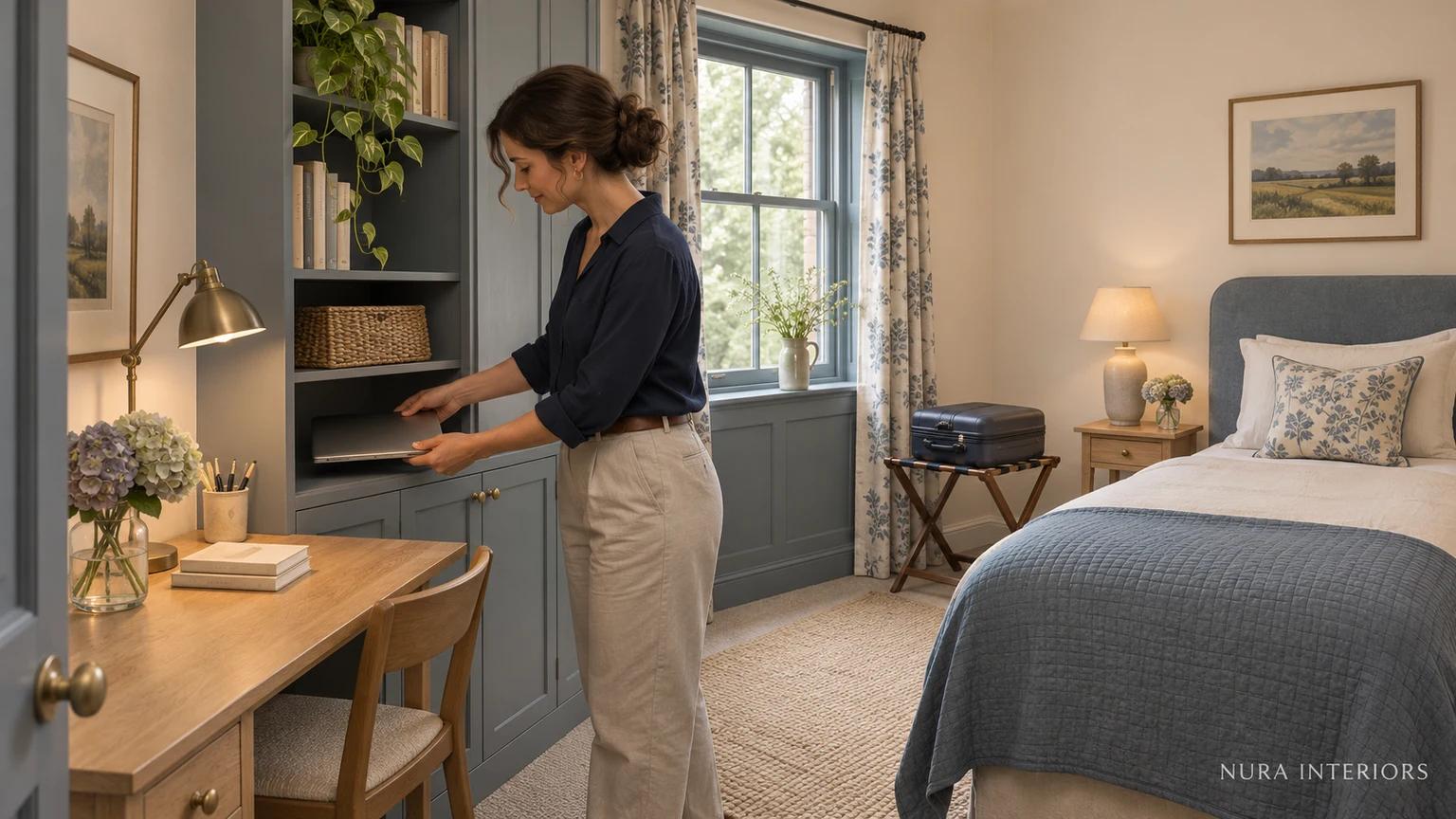

A home office in a guest bedroom needs a plan for the visit, not only a desk that looks discreet beside the bed. Before choosing furniture, decide whether work stops while guests stay or continues in an identified place elsewhere. Putting the laptop away on Friday does not answer where Monday's work will happen.
That decision shapes the joinery brief. It affects which belongings need to remain available, which storage guests can use and whether the room is genuinely handed over for their stay. Start with a particular visit and the work expected during it, rather than assuming that daytime and night-time uses will never overlap.
Start with Friday's arrival and Monday's work
Imagine a household using a spare bedroom as its weekday office. Guests arrive on Friday and leave on Tuesday. The room has a fixed guest bed, a compact desk, an office chair and work storage. The person who uses it has laptop work and papers to refer to on Monday. This is a hypothetical brief, not a Nura project.
On the normal working day, the laptop and active folder sit on the desk. The chair is pulled out and a bag rests beside the desk. For the visit, the guest needs the bed, somewhere to unpack and a place for their suitcase. Show those belongings and positions on the actual room proposal, including access to the bed, wardrobe and door.
Now ask what happens on Monday. If the plan relies on entering the guest's room to retrieve the folder or use the desk, that is still part of the proposed arrangement. A closed cupboard can change the view, but it cannot decide when the guest has the room to themselves or when someone else may need access.
Choose whether work pauses or has another home
If work can stop for the whole visit, record that as an accepted use of the room. Identify which materials may remain stored there and what must be put away before arrival, according to the owner's requirements for those items. Do not describe a decorative front as providing security or confidentiality.
In this example, however, Monday's work must continue. The household therefore needs an actual alternative, not a note saying work elsewhere. Suppose it proposes the existing desk in a separate study. Confirm that desk is available on Monday, that the person who normally uses it agrees, and that the necessary equipment and papers can accompany the work.
If the study is already occupied, the alternative is not settled. Nor is the dining table automatically available for a working day because it can hold a laptop. Its meals, other users and the work involved belong in that discussion. The household may need another agreed working arrangement, a change to the visit plan or a reconsidered room brief.
Only after that decision should the guest-bedroom storage be developed around it. A concealed desk may be a preferred appearance, but it is not a substitute for deciding where active work goes. Keep the changeover manageable by identifying the things that actually need to move, rather than making an empty-room photograph the standard.
Give the changeover concrete destinations
For the proposed study arrangement, the closed laptop, its necessary accessories, the active folder and the work bag go to the agreed study before the visit, with the working materials allocated to that desk. Papers not needed during the stay remain in an identified guest-room work compartment, subject to the owner's storage requirements. This avoids assuming that every work item must leave, while keeping Monday's needed materials outside the guest's room.
The office chair also needs an agreed position. If it is retained in the guest room, show where it sits while the bed and guest storage are in use. If it leaves, identify a real destination and review that arrangement rather than shifting its outline into an unspecified corridor. Do not assume a chair symbol tucked under the desk represents the actual chair.
In the hypothetical room, a designated guest drawer is left available for unpacking and the suitcase position appears on the guest-state plan. Neither is filled with displaced office belongings. If the household cannot provide those places without losing essential work storage, resolve that trade-off before describing the room as ready for visitors.
Keep the instructions specific enough to follow: laptop, active folder and work bag to the agreed study; remaining work papers in their identified compartment; chair in its reviewed position; guest drawer available; suitcase in its planned place. The room drawing should support those destinations. No universal changeover time follows from this list.
Plan the return to work as well
After Tuesday's departure, the household returns the laptop and active folder to the guest-room desk, puts the work bag back in its identified place beside the desk and restores the office chair to its working position. Identify what happens to guest bedding and any belongings that stay in the room. Otherwise the office may only reappear after another cupboard or surface has been borrowed.
Review the arrangement with the actual furniture and selected products. Bed operation, furniture movement, electrical equipment and any fitted components need their applicable information and appropriate professional response. This scenario identifies a household decision; it does not establish technical fit, individual comfort or permission to alter a bed or desk mechanism.
For the wider furniture brief, explore Nura architectural joinery and bring the normal work layout, guest-state plan and Monday working arrangement to a design conversation. Explain what must remain accessible and which destinations are still unresolved. Ask which joinery scope the studio can develop, so the furniture proposal follows an agreed way of sharing the room.