
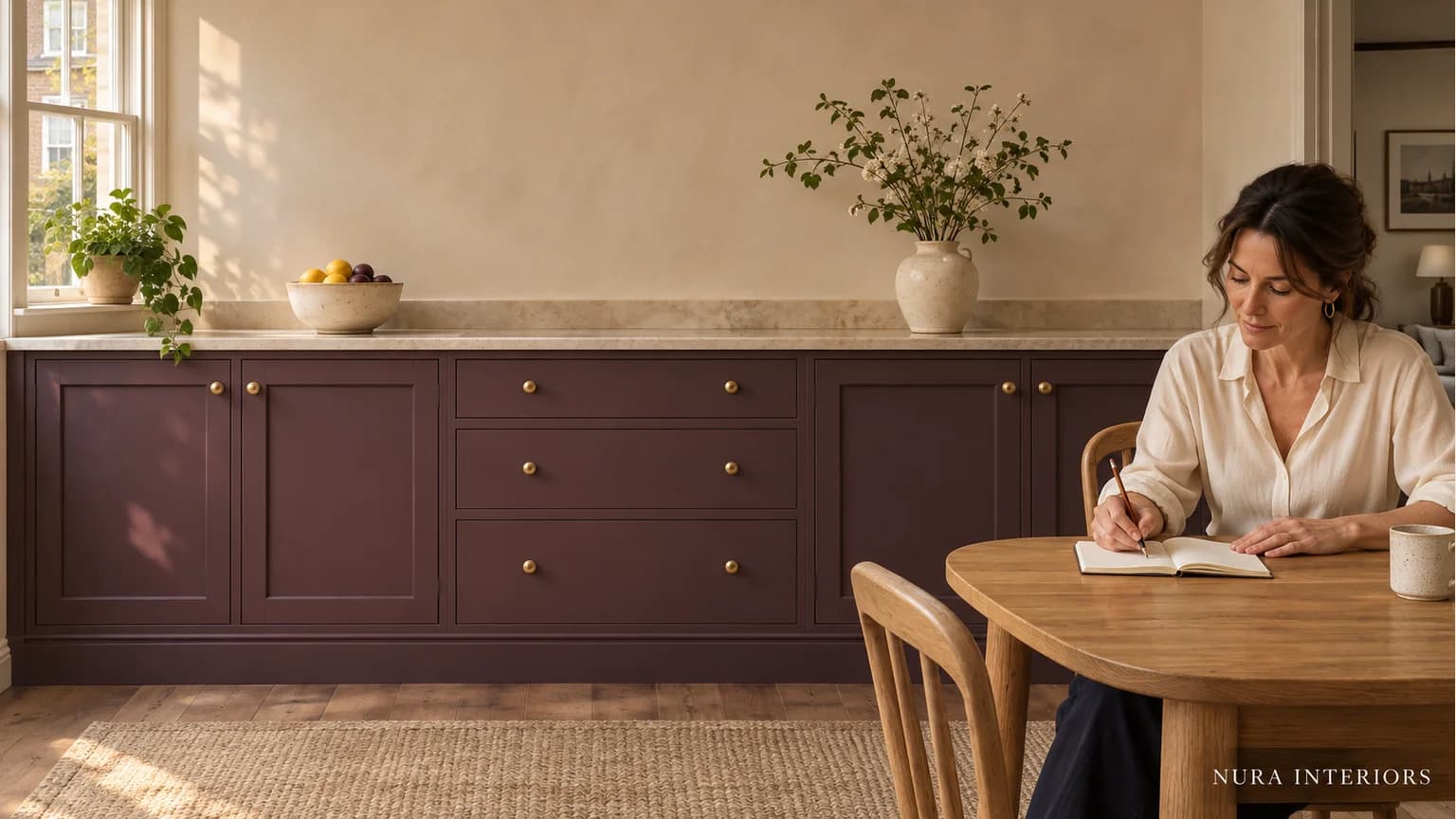

Handmade kitchen cabinets can be described in quite different ways by their suppliers. Before treating the word as a reason to order, find out what it covers in the actual proposal and what choices it gives you for your room. A production description, freedom to alter a cabinet and the condition in which it arrives are separate questions.
Start with the design decision you need resolved. Perhaps one cupboard should have a different proportion, or a retained feature changes the intended cabinet run. Ask how that requirement would be developed within the supplier's offering rather than assuming the handmade label already answers it.
Begin with the cupboard you want to change
Imagine a household that likes a proposed kitchen range but wants one cupboard to sit differently beside a retained doorway. It is considering a different front proportion while keeping the neighbouring storage arrangement. The supplier describes its cabinetry as handmade, so the household initially expects any change to be straightforward. This is a hypothetical brief, not a Nura project or a claim about a particular manufacturer's process.
Turn that expectation into a specific design request. Identify the cupboard on the drawing and explain which relationship matters: the front's proportions, the line beside the doorway or the interior it provides. Ask which changes are available and which would need further development. Do not ask the word handmade to stand in for that response.
The answer could involve an offered range option, a developed alternative or a limitation the household needs to understand. None should be guessed in advance. If a change is unavailable, the useful next discussion is what other arrangement meets the priority, not whether the supplier's label is automatically wrong.
Ask what the production description covers
Invite the supplier to explain its use of handmade in relation to the identified proposal. Which components or operations is it describing? Does the explanation apply to the whole kitchen or particular parts? What evidence or relevant example can help you understand that account?
Keep this an enquiry about the actual offering rather than a test that demands one universal manufacturing method. A workshop photograph may illustrate a process without identifying every operation used for your order. Equally, a finished kitchen image shows an appearance; it does not prove which tools or processes produced it.
Do not assume hand work excludes machinery, requires a particular joint or establishes the material of every component. The complete construction and its suitability need their own relevant specification. Our cabinet-unit guide explains why body, front and interior descriptions should be read separately when those terms need clarification.
Separate handmade from the available design changes
The White Kitchen Company's London page describes its handmade offering alongside a modular system. That is information about its own range, not a contradiction to resolve by inventing a universal definition. It illustrates why the customer should ask what is selected from an offering and what can actually change.
For the hypothetical cupboard, request a representation of the proposed alternative within the whole run. Does it retain the intended storage and front relationship, or introduce another difference? A preferred proportion is not complete if the interior shown belongs to the earlier version.
Keep fixed choices visible too. A household may value a particular finish or front design more than a requested variation. Understanding the actual options allows it to decide what matters, rather than collecting attractive descriptions that leave the design unresolved.
This does not mean every kitchen needs unrestricted alteration. A relevant range option may suit the room. Another brief may need different development. The point is to understand which route is actually offered for the requirement in front of you.
Find out what arrives and what happens next
The manufacturing description does not automatically identify the supplied finish, assembly or fitting scope. The Painted Kitchen Company's bespoke product page, for example, describes its own primed supply and separate painting or fitting arrangements. The White Kitchen Company describes assembled delivery within its own offering. Neither description applies to every handmade kitchen or establishes Nura's services.
Ask what state the actual cupboard would arrive in and which remaining work the proposal includes. A primed appearance reference and a finished sample answer different questions. An assembled unit and an installed cabinet are also different stages.
Connect the answer to the household's decision. If it accepts the changed cupboard proportion, which drawing represents it? Which finish reference applies, and what still needs doing before the cabinet is complete? Keep the relevant responsibilities identified without assuming one production label makes them all part of the same appointment.
| Description | Apply it to the actual cupboard | Useful outcome |
|---|---|---|
| Production | What does handmade describe here? | Supplier explanation tied to the proposal |
| Design choice | What can change for this room? | Actual offered arrangement and its implications |
| Supplied state | How does it arrive and what work remains? | Included finish, assembly and fitting scope understood |
For samples, our joinery sample guide distinguishes a finish reference from other kinds of evidence. For the complete commercial comparison, use the kitchen-quote guide rather than treating a production word as a value judgement.
Frequently asked questions
Does handmade mean every cabinet can be any size?
Do not assume unrestricted alteration. Describe the actual change you need and ask what the supplier offers for that proposal.
Does the word tell me how the kitchen will arrive?
No complete supply scope should be inferred. Confirm the actual assembly, finish and remaining work separately.
Does a workshop or finished-kitchen photograph verify the whole description?
It can provide context, but ask what it represents and how it relates to your proposed order. Appearance alone does not establish every production step or component.
Explore Nura bespoke kitchens, then bring the particular cupboard question, room view and current proposal to a design conversation. Ask which changes and relevant examples can be considered within the agreed scope. No particular manufacturing process or workshop visit should be assumed.