
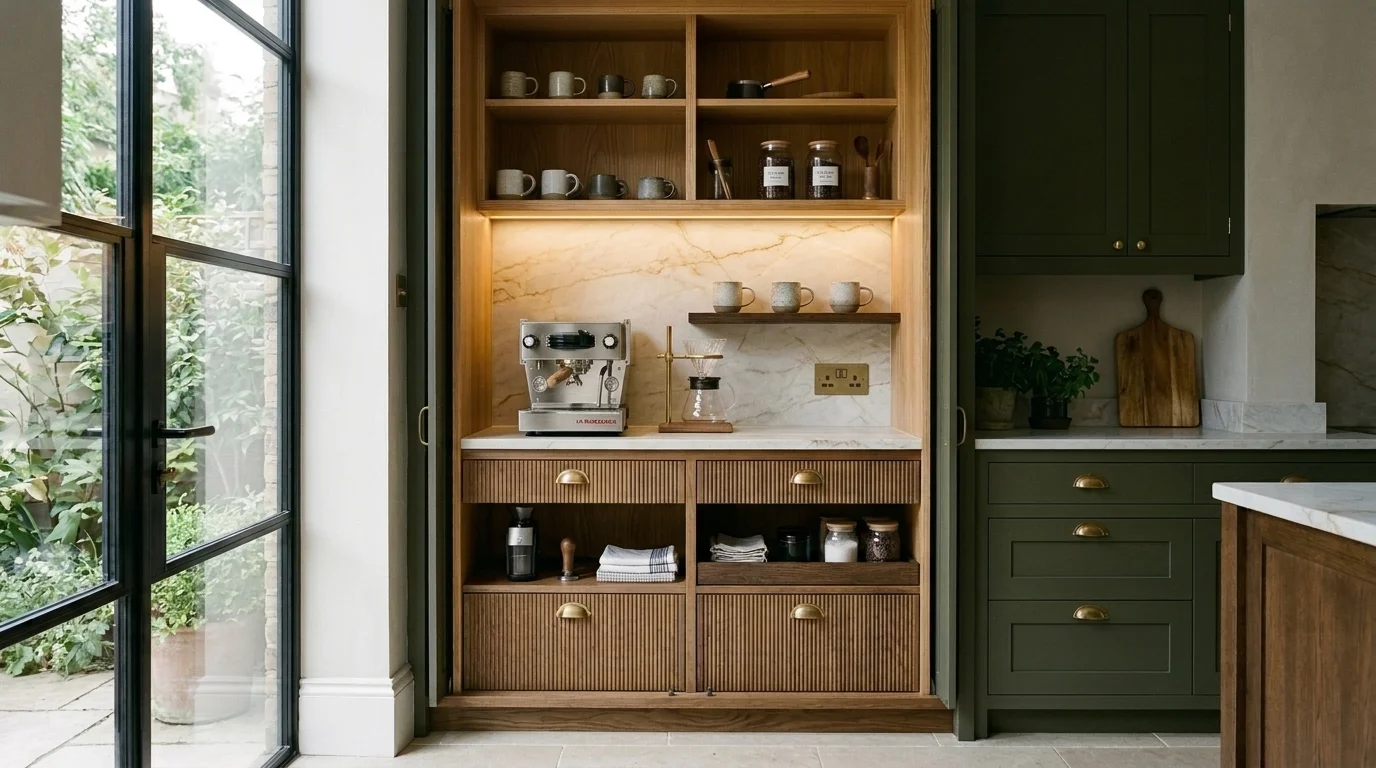

In extended Victorian and Edwardian homes across Fulham, Chelsea, and Wandsworth, the morning routine frequently collides with architectural circulation. When preparing artisan espresso or toasting sourdough in an open-plan kitchen, leaving conventional 600mm wide cupboard doors open blocks the vital thoroughfare between island and garden glazing. While a dedicated walk-through scullery or prep kitchen resolves preparation clutter in larger homes, compact and medium extensions demand a high-density joinery solution: a bespoke pocket-door breakfast station. When closed, it presents a monolithic wall of tactile fluted timber; when opened, the doors slide effortlessly into lateral pockets, unveiling a fully functional working station.
The Circulation Bottleneck in London Kitchen Extensions
Standard larder units with hinged doors project 600mm to 650mm into the room when fully opened. In a typical 4.5-metre wide London Victorian side-return extension—where kitchen designers must accommodate a 1,000mm deep island and 1,100mm perimeter walkways—two open cabinet doors reduce clearance to an awkward 450mm pinch point. Family members are forced to squeeze past hot appliances, spilling drinks and creating congestion during peak morning hours.
By specifying pocket door systems—where the doors pivot 90 degrees and glide flush into concealed pockets built into the cabinet carcass—the walkway remains 100% unobstructed. Homeowners can leave the breakfast bar open throughout brunch entertaining, then slide the doors shut in three seconds before evening guests arrive at our bespoke Chelsea kitchen showroom consultation sessions.
Millimetre Clearances: Net Worktop Depth for Heavy Appliances
The most common architectural failure in pocket pantries is insufficient cabinet depth. A standard 600mm external kitchen cabinet fails completely when fitted with pocket mechanisms. Pocket runner hardware (such as Hawa Concepta or Blum REVEGO) consumes 55mm to 75mm of lateral space on each side and requires an 80mm front setback. Furthermore, a 50mm rear service void is essential for electrical conduits, socket backboxes, and water isolation valves.
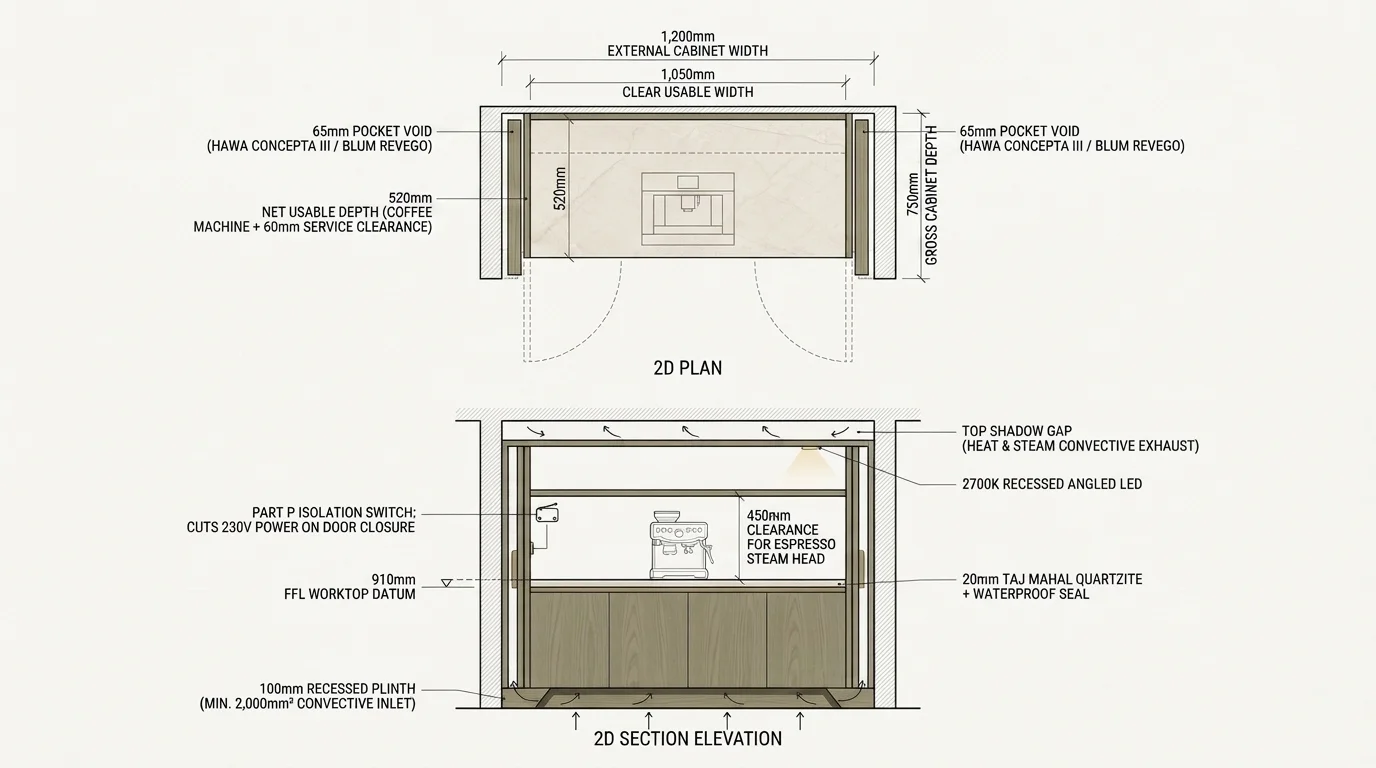
Consequently, a 600mm gross depth cabinet leaves only 420mm of net usable worktop—far too shallow for high-end dual-boiler coffee machines. A La Marzocco Linea Micra measures 377mm deep, but requires a minimum of 80mm behind it for power cables and plumbing lines, plus 60mm in front for the drip tray and portafilter clearance. Therefore, NURA cabinetmakers specify a minimum gross depth of 750mm (or 700mm absolute minimum), guaranteeing a 520mm net usable stone counter surface.
Pocket Void Engineering: Hawa Concepta III vs Blum REVEGO
Choosing the correct pocket hardware determines whether doors operate with hydraulic silence or jam under daily household use. In British luxury joinery, two systems dominate the specification landscape:
Hawa Concepta III: The Swiss benchmark for single and bi-folding pocket doors. Its scissor-arm guidance mechanism prevents door deflection without requiring a floor guide channel across the worktop, preserving a pristine stone surface. It accommodates door leaf heights up to 2,700mm and weights up to 50kg per door leaf. It requires a 55mm to 65mm pocket cavity width.
Blum REVEGO: The Austrian engineered solution featuring a fully pre-assembled pocket unit ('pocket cassette'). It allows single (REVEGO uno) or double (REVEGO duo) doors with intuitive TIP-ON mechanical push-to-open activation. Double pocket units require a 150mm pocket housing (75mm per leaf), meaning a 1,200mm external unit delivers an internal clear aperture of 1,050mm.
UK Approved Document Part P: Mandatory Electrical Isolation
Enclosing high-wattage heat-generating appliances—such as 3,000W electric kettles, multi-slot toasters, and steam ovens—inside closed timber joinery creates an immediate fire hazard. Under UK Building Regulations Approved Document P (Electrical Safety in Dwellings), electrical installations must not cause danger or fire.
At NURA, our architectural specification mandates an integrated plunger micro-switch (limit switch) mortised into the pocket door rebate. The moment either pocket door is pulled out of its pocket to begin closing, the contact mechanically breaks, de-energising a 32A contactor on the dedicated pantry radial circuit. Power to all internal 230V socket outlets is instantaneously severed. Even if children leave a 4-slice toaster operating or a boiling kettle steaming, closing the doors safely eliminates the ignition risk before timber temperatures can climb.
Thermal Management & Convective Airflow: Protecting Veneers
Even with electrical isolation when closed, commercial espresso machines and Quooker boiling water tanks emit substantial standby heat and steam during hours of open operation. If steam becomes trapped against natural timber veneers or painted MDF carcass sides, differential moisture absorption causes delamination, micro-cracking, and mould growth.
To prevent thermal stagnation, bespoke breakfast pantries must incorporate passive convective ventilation. We engineer a 100mm recessed plinth with an acoustic shadow-gap inlet (providing a minimum 2,000mm² free ventilation area) beneath the carcass. In the top soffit or crown pelmet, an unobtrusive continuous 20mm shadow gap allows warm air to escape into the ceiling plenum. Cooler room air is naturally drawn upward through the service void, maintaining internal relative humidity below 60%.
Material Specification: Sing Core, Birch Plywood & Stone
Pocket doors measuring 2,200mm to 2,700mm in height are highly vulnerable to seasonal warping. A bow of just 3mm along the door height will cause the leaf to rub against the pocket housing, scoring the lacquered finish and jamming the glide mechanism. To eliminate warping, NURA constructs pocket door leaves exceeding 2,100mm using insulated aluminium Sing Core panels or balanced 18mm cross-laminated birch plywood cores, backed with internal concealed tensioning straighten rods (planarity adjusters).
For the worktop and splashback, we specify 20mm honed Taj Mahal quartzite or Brazilian granite with a 400mm seamless upstand, treated with penetrating fluoro-chemical sealers. Quartzite withstands hot coffee splashes, boiling water scalding, and citrus acidity without etching. Fluted interior drawer fronts in crown-cut olive ash or American black walnut—matching our 2027 luxury kitchen colour palettes—introduce tactile elegance when the doors glide open.
Frequently Asked Questions: Pocket-Door Breakfast Pantries
What is the absolute minimum depth for a pocket-door breakfast pantry in the UK?
The absolute minimum external cabinet depth is 700mm, with 750mm strongly recommended by RIBA kitchen designers. This accommodates the 80mm pocket runner mechanism, a 50mm rear electrical service void, and leaves 520mm of net usable stone counter depth—the exact clearance needed for commercial-grade domestic coffee machines and rear cable management.
How do you prevent tall pocket doors from sagging or binding over 2.4-metre heights?
Preventing deflection in tall pocket doors requires three engineering measures: constructing door cores from torsionally stable materials (such as Sing Core honeycomb aluminium or premium birch ply), fitting internal two-way tension adjuster bars inside routed door rebates, and specifying heavy-duty hardware like Hawa Concepta III rated for up to 50kg per leaf with 3D micro-adjustment.
Does UK Building Regulations Part P require automatic power shutoff in closed pantries?
While Approved Document P does not prescribe individual joinery switches by name, it strictly mandates that electrical installations prevent fire hazards. In prime London residential refurbishments, local Building Control officers and insurance underwriters insist on automatic plunger micro-switches that de-energise internal socket circuits whenever pocket doors are closed over heat-generating appliances.
Can boiling water taps like Quooker be installed inside a pocket pantry?
Yes, provided the installation includes a prep sink, dedicated cold water supply, waste trap, and adequate base cabinet ventilation. The Quooker PRO3 or PRO7 vacuum-insulated tank must be housed in a ventilated base cupboard with passive plinth louvres to prevent heat accumulation around the boiling chamber.
What is the difference between Blum REVEGO and Hawa Concepta III pocket door hardware?
Blum REVEGO uses a modular pre-assembled pocket housing cassette that simplifies on-site installation and features mechanical push-to-open (TIP-ON) activation without visible handles. Hawa Concepta III offers exceptional bespoke flexibility for oversized doors up to 2.7 metres, utilising an advanced scissor-arm mechanism that operates with zero bottom floor track.
How much does a bespoke pocket-door breakfast pantry add to project costs in London?
A fully engineered bespoke pocket-door breakfast pantry (1,200mm to 1,500mm wide, floor-to-ceiling) typically ranges between £7,500 and £14,000 + VAT depending on timber veneers, stone fabrication, and hardware specification. You can model exact cabinetry allowances using our interactive bespoke kitchen cost calculator before commissioning technical drawings.