
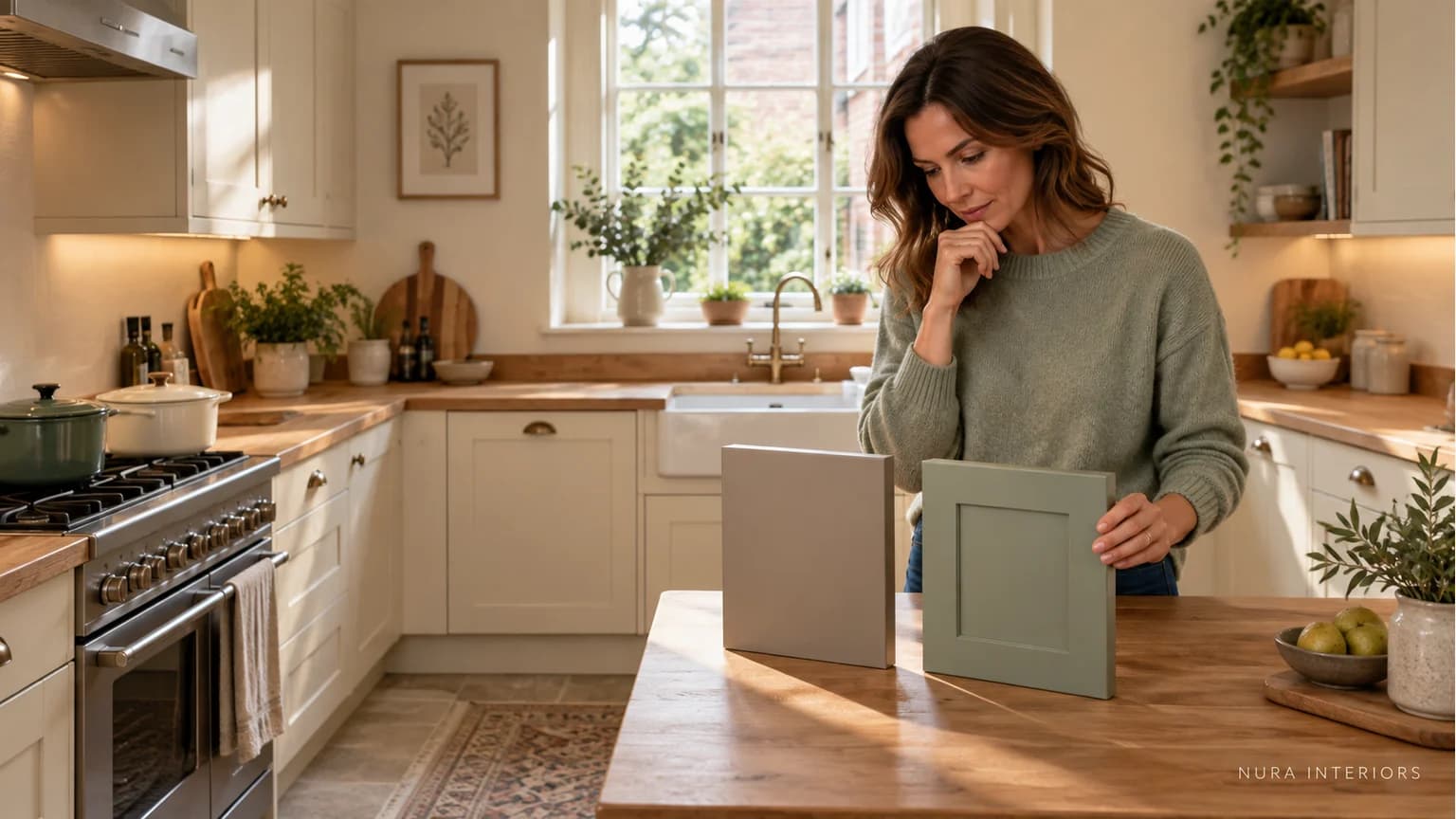

Replacing kitchen doors can address a wish for different fronts, but it does not automatically change the cabinet interiors, appliance arrangement or layout. Before comparing a front-only proposal with wider work, separate three questions: what you want to look different, what needs assessment and what you want to work differently each day.
Then identify the actual items retained and changed in each proposal. A photograph cannot establish whether existing cabinetry is suitable for new fronts, and a new colour alone cannot resolve an awkward storage arrangement. The useful comparison is between defined scopes for your kitchen, rather than a universal rule to reuse or rebuild.
Describe the frustration before selecting the solution
Make a short list in the household's own words. “I dislike the cream fronts” describes appearance. “The pan cupboard is awkward to use” describes a storage task. “This door no longer closes as expected” identifies an issue that needs an appropriate response, not a diagnosis of its cause.
Keep those observations separate. They may lead to different work, and one proposed solution need not address them all. Ask the relevant supplier or professional to identify what information and assessment are required for the existing kitchen and the proposed products.
Avoid treating visible wear, the kitchen's age or one nominal dimension as a decision by itself. Equally, do not assume that familiar-looking fronts can be swapped without considering the cabinetry, fittings and appliances they relate to. Establish what the actual proposal permits before ordering parts.
Separate treating the coating from replacing the front
Retaining a drawer front while treating its coating is a different proposal from supplying a new front. Sherwin-Williams' paint-touch-up guide notes, in its cabinet-and-trim section, that smooth, glossy finishes make touch-ups more challenging. That observation does not establish which treatment, if any, suits an existing sprayed or lacquered kitchen finish.
Imagine a household noticing one visible mark on a painted drawer front whose appearance it otherwise likes. Ask the appropriate supplier or finisher to assess the actual coating and explain the scope being considered. Would treatment concern the marked area, the whole face, the complete front or adjoining parts? The mark alone should not decide that scope or establish the condition of the front beneath it.
Discuss the expected visible relationship with the neighbouring fronts before choosing an option. What evidence or representative example can explain the result being offered, and what difference might remain? The household can then compare retaining the front with a defined coating treatment against replacement, understanding the appearance each proposal addresses without assuming an invisible repair.
Follow a colour wish and a storage problem
Imagine a household that wants to replace its cream fronts with a quieter painted colour. It likes the kitchen's general position in the room, but the everyday pans are difficult to retrieve from one cupboard. The household hopes a front refresh will make the whole kitchen feel resolved. This is a hypothetical brief, not a Nura project or an assessment of an existing cabinet.
First, identify what a front-only proposal would change. Does it include cupboard doors and drawer fronts? Which handles and fittings are retained or replaced? What happens to visible side panels, plinths and appliance fronts? A new door colour may create another appearance question beside those retained surfaces.
Next, follow the pan-storage routine separately. Ask what would change inside that particular cupboard, if anything. Replacing its front might leave the same retrieval problem. A different internal arrangement may be worth discussing, but it needs its own product compatibility, usable-space and scope confirmation. Do not quietly count that work as part of a door-only quotation.
The household might decide that the colour change is enough for now, with the storage limitation clearly understood. Or it might compare a wider proposal addressing the cupboard. The decision should describe the accepted compromise rather than present one option as automatically better.
Make retained and changed items visible
Use the current kitchen plan or an identified set of photographs to locate the items being discussed. Record the existing product information where known, including relevant appliance references. Leave missing information open for confirmation instead of filling it with an assumption.
| Decision | Identify in the proposal | Confirm before ordering |
|---|---|---|
| Appearance | Fronts, handles and visible surfaces retained or changed | Actual style, finish and adjoining relationships |
| Existing arrangement | Relevant cabinets, fittings and appliances | Required assessment and compatibility with the proposal |
| Everyday use | Specific storage or layout problem | What the scope changes and which limitation remains |
For integrated appliances, ask the appropriate parties to confirm the actual arrangement rather than assuming a matching front size settles it. Keep any response with the relevant appliance and cabinet reference.
Choose the front after defining its scope
Once the proposed work is clear, compare the actual style and finish across the fronts your kitchen needs. Our Shaker versus slab guide considers the whole elevation, including drawers and tall units, rather than one sample door.
If the intention is to remove visible handles, distinguish that appearance wish from the proposed opening system. Our handleless kitchen guide explains why changing fronts does not necessarily create the same arrangement as a new rail-based kitchen. Have the actual retrofit possibilities confirmed; do not assume that removing a handle establishes the answer.
Keep sample acceptance separate from technical confirmation. Liking a colour or profile is not approval of the retained cabinet condition, selected fittings or complete installation.
Compare quotations for the same stated work
Ask each proposal to identify supply, fitting, removal, finishing and any separate changes. Clarify which panels, trims, handles and appliance-related work are included. If an item is unanswered, mark it unresolved rather than treating it as free or excluded by default.
Compare the front-only proposal with wider work against the same household priorities. Record the problems each addresses and what remains unchanged. A lower headline amount does not establish a like-for-like saving when the included work differs, and a wider scope does not prove that every retained item needs replacing.
Have relevant site, product and installation requirements confirmed by the appropriately appointed parties. This guide does not provide inspection thresholds, repair methods or permission to alter existing cabinetry.
Frequently asked questions
Can I replace just the kitchen doors?
Ask the supplier to assess the actual existing arrangement and proposed fronts. Confirm what can remain, what must change and which information is still needed before ordering.
Will new doors fix poor storage?
Not automatically. Identify the retrieval or capacity problem separately and ask whether the proposed scope changes the interior or only its front.
How should I compare a refresh with a new kitchen proposal?
Use the same priorities and identify the included work, retained elements and unresolved questions for each. Do not compare headline prices as though different scopes were identical.
Explore Nura bespoke kitchens, then bring photographs, known appliance references and a retained-versus-changed list to a project conversation. Ask whether the requested scope can be considered and which relevant examples are available. A replacement-only service should be confirmed rather than assumed.