
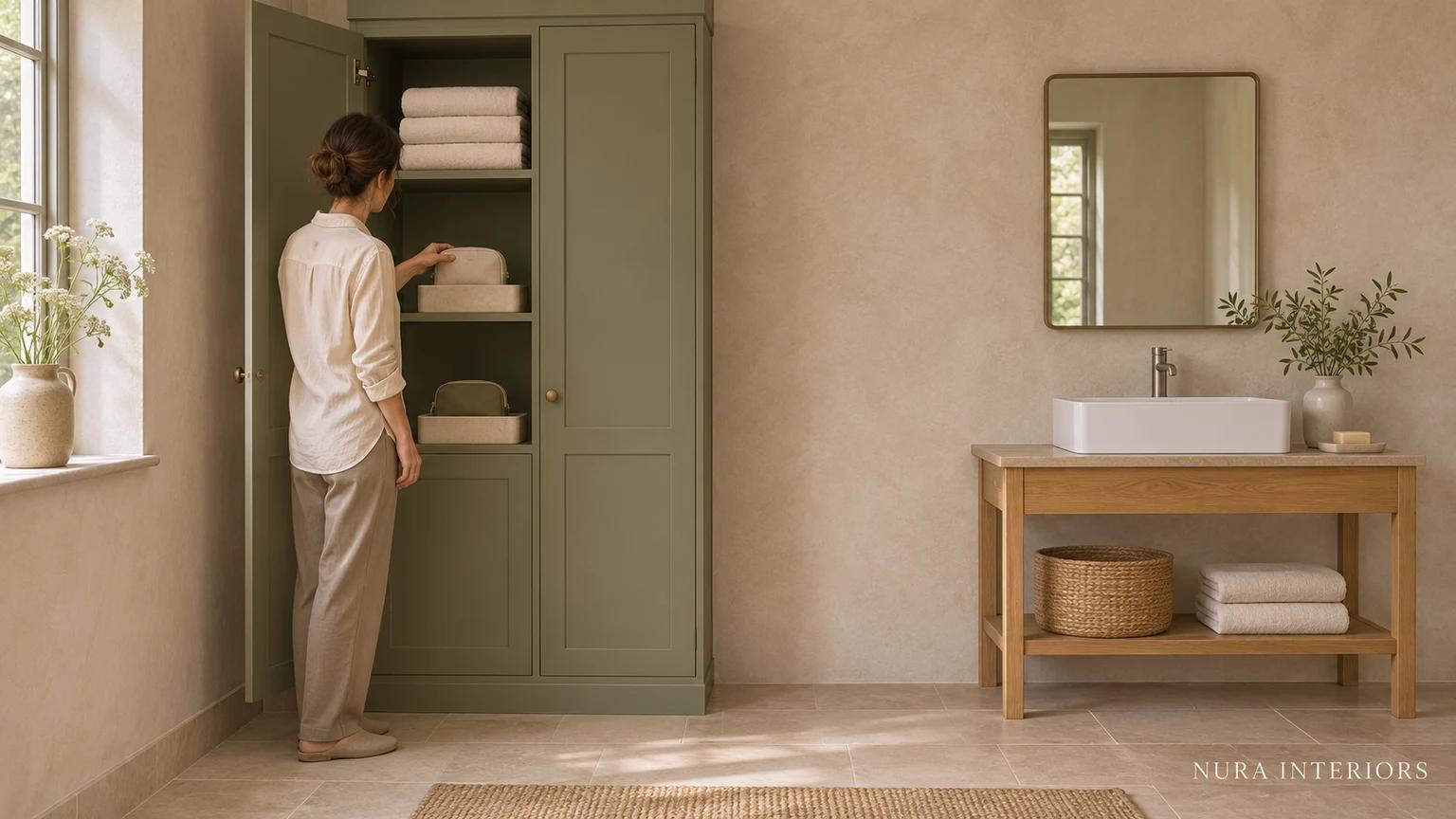

Shared bathroom storage needs to answer more than where each person's belongings fit. It should explain how somebody retrieves and returns them while the room is being used. Before giving every item a place beneath the basin, consider which things need to be there and which could have an identified home elsewhere.
For two adults sharing one bathroom, personal storage and shared reserves create different questions. A daily item needs an agreed place between uses; an unopened replacement does not necessarily need that same position. The useful brief connects ownership, retrieval and return without assuming that everyone can use the room at once.
Start with the moment somebody needs their belongings
Imagine two adults planning bathroom furniture around one basin. One is using the basin while the other wants their own comb and personal toiletries before getting dressed elsewhere. At present, both people's belongings are proposed for drawers directly beneath the basin. This is a hypothetical planning example, not a Nura project or a checked arrangement.
A drawer assigned to each person identifies ownership, but leaves the second person's retrieval unresolved at that moment. Ask the developed proposal to show the person at the basin, the relevant drawer opening and the other person's approach. Do not assume a labelled drawer provides independent access.
Decide whether that overlap matters to the household. If they normally use the bathroom separately, waiting may be an acceptable part of the routine. There is no need to add a cabinet simply to support simultaneous use they do not want. If they do want to retrieve belongings while the basin is occupied, make that particular request explicit.
Give personal belongings an actual storage and use arrangement
For this household, suppose the second adult wants to collect the comb and toiletries without using the basin at that time. Ask for a separate proposed cabinet to be represented away from the basin, with an identified personal compartment. Show its opening, the intended contents and the approach alongside the rest of the occupied room.
The cabinet's different position is a proposal to review, not proof that both people can use the bathroom together. Its door or drawer may introduce another interaction with the room entrance or the person passing. Have the actual arrangement considered before treating the request as resolved.
The household also needs to say where the collected belongings are used. In this example, the second adult takes them to an existing bedroom dressing surface that they intend to keep available. That destination belongs in the routine. Do not quietly replace the bathroom-basin conflict with an unexamined claim on another person's surface.
After use, those belongings return to the same identified personal compartment. The basin user's personal items have their own agreed place and return routine too. A tidy empty cabinet image cannot establish that this is where the household will actually put things away.
If the separate cabinet or bedroom destination does not suit the developed arrangement, the household can choose sequential bathroom use instead. It can also ask for the furniture proposal to be revised. Neither answer requires declaring that more storage or another basin automatically solves the original issue.
Keep shared reserves from absorbing the personal allocation
Now add the things both adults share, such as spare toilet rolls, reserve hand towels and unopened replacements for an agreed shared product. Name their actual proposed storage separately from the personal compartments. Otherwise the space allocated to one person's daily belongings may be counted again as room for the household reserve.
Ask who will notice when an in-use item needs replacing and where the replacement is collected. This is an agreement about the household's routine, not a prescribed restocking schedule. Shared contents should not become one person's unspoken responsibility merely because their compartment happens to be nearby.
If the selected cabinet cannot accommodate both the personal allocations and the reserve group in the developed proposal, identify the compromise. The household might retain personal storage nearby and keep some reserves in an existing linen cupboard, if that cupboard and its users genuinely accept them. Alternatively, it may reconsider the actual furniture arrangement. An unspecified elsewhere leaves the storage question open.
Keep the basin's in-use surface in this discussion. Identify what the household expects to remain there and what returns to storage, rather than assuming the whole surface will be empty after every routine. Personal ownership does not decide the room view by itself; that visible arrangement is another preference to agree.
Bring the shared-use decision into the furniture brief
Record each person's stored group, where it is used and where it returns. Add the shared reserve destination and the household's accepted approach to overlapping use. A short account of the actual routine is more informative than a general request for plenty of bathroom storage.
Keep product suitability and the associated work separate from that allocation. The exact furniture, finish, basin arrangement and room conditions need the applicable supplier information and appropriate professional responses. Choosing a personal compartment is not approval of a cabinet installation or a statement about its performance.
For the separate basin-and-furniture decision, our compact cloakroom vanity guide explains why a closed-front image cannot establish the complete proposal. Explore Nura architectural joinery and bring room photographs, the personal and shared storage brief, and any unresolved access question to a project conversation. Ask whether this furniture scope is something the studio can develop and which supplier or specialist responses are required; a bathroom-fitting service should be confirmed rather than assumed.