
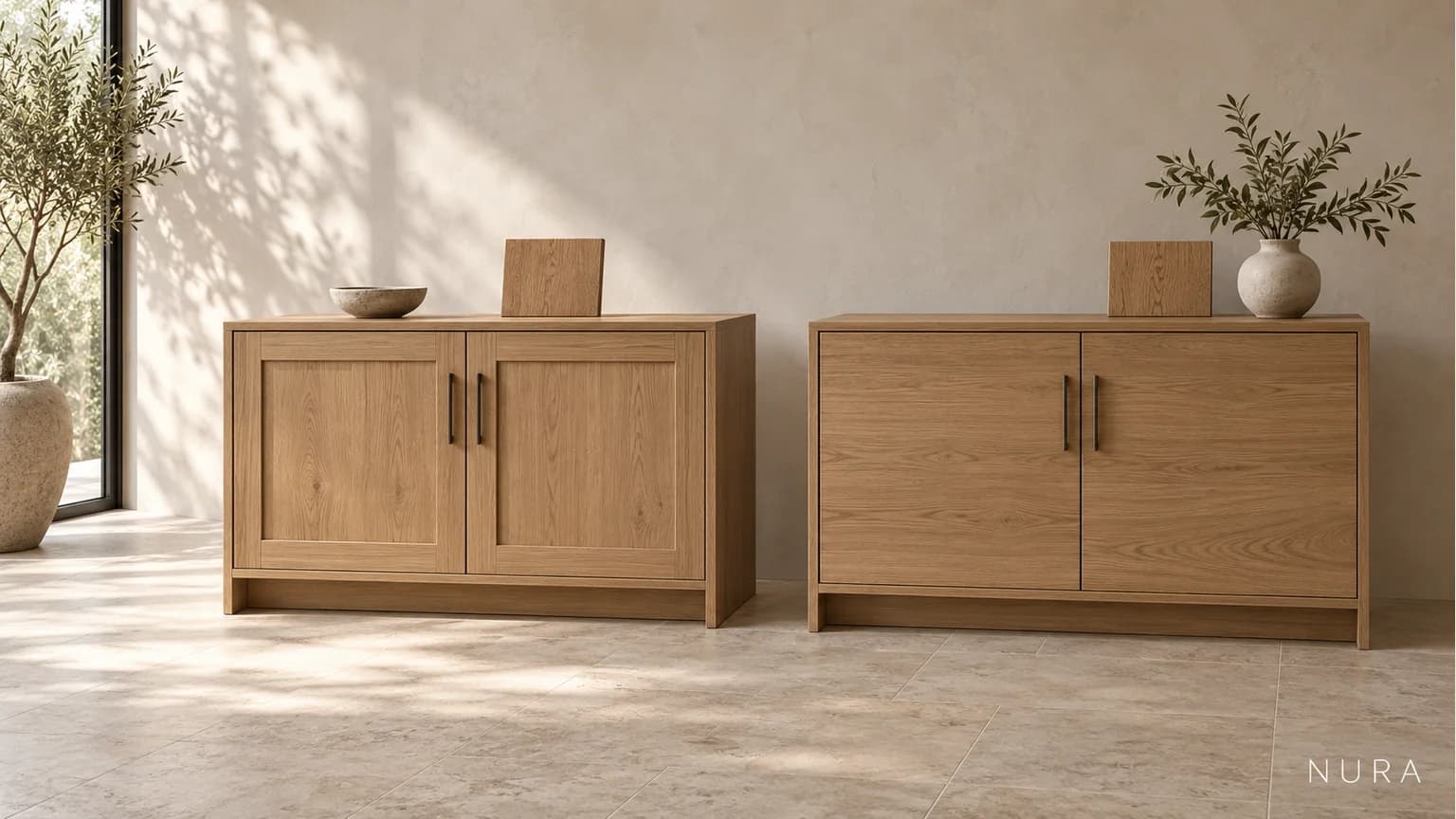

Value engineering bespoke joinery starts by asking what the furniture must still do after a proposed change. Write down those needs, compare the alternative against them and obtain a revised price for the complete affected scope. A simpler-looking cabinet is not evidence of a saving, and a lower quotation does not explain what the client is giving up.
For architects, interior designers and developer teams reviewing a residential joinery package, the useful decision is whether a particular alternative offers an acceptable balance of cost, use and appearance. This guide uses an unpriced hypothetical dining-room cabinet to show how to make that judgement visible.
Agree what you are trying to preserve
SAVE International describes value methodology as analysing functions while balancing performance, quality, safety and cost. Applied to a joinery discussion, begin with the purpose of the furniture rather than a list of expensive materials to replace. This is a practical comparison aid, not a formal value-methodology study.
Imagine a cabinet fitted into a dining-room alcove beside an open-plan kitchen. The household wants plates behind closed doors, a drawer for cutlery and a clear route around the dining table. The designer wants the door divisions to sit comfortably with the adjacent kitchen. Record those priorities separately: concealed storage, accessible cutlery, circulation and the visible composition.
Then ask which priorities are essential and which the client is willing to reconsider. If a decorative frame is central to the agreed room, removing it changes more than a detail. If it was only one possible expression of the brief, a simpler front may be worth exploring. The client needs to see that difference before accepting a new sum.
Compare one proposed change at a time
Keep the original proposal identifiable and ask for alternatives separately. Otherwise a new front, different interior and narrower cabinet can arrive as one lower figure, making it difficult to understand which change produces which effect.
| Alternative | Retain | Trade-off | Confirm |
|---|---|---|---|
| Simplify a framed front to a slab front | Closed storage and the agreed cabinet arrangement | The door detail changes; its relationship with the kitchen needs review | Revised elevation, proposed finish and construction, and actual revised quotation |
| Replace the cutlery drawer with a shelf | The outer cabinet and closed storage | Cutlery storage changes; a tray elsewhere may be needed | A workable place for the actual contents, revised interior and net price difference |
| Explore a standard-width cabinet with fillers | A closed cupboard within the alcove | Usable width, door proportions and filler lines may change | Surveyed fit, clearances, finishing and fitting scope, and complete installed quotation |
None of these alternatives is automatically cheaper or technically equivalent. Ask the supplier and relevant project specialists to confirm suitability for the intended contents, fittings and location. A visual comparison can help with appearance; it cannot establish load capacity, durability or installation requirements.
Name a reduced requirement honestly
In the cabinet example, removing the drawer does not remove all storage, but it does remove the intended cutlery arrangement. The client may happily accept a tray in another location. Record that as an agreed change to the requirement, rather than saying nothing has been lost.
Likewise, omitting an entire cabinet may be a sensible budget decision if the household no longer needs it. It is a scope reduction. Keeping the distinction clear allows the client to choose a smaller brief without confusing it with an alternative that fulfils the original brief. Do not reject a useful reduction simply because it is not like-for-like.
Ask for the total effect, not a material-price guess
Request the original and revised amounts on a consistent basis, with the affected work identified. Ask whether the change alters drawing development, samples, manufacture, delivery, fitting or making good. Check the treatment of VAT and any separately priced work. Use the bespoke joinery quote comparison when the figures cover different scopes.
Before calling the difference a saving, establish whether redesign, changed adjacent work or existing order commitments add costs elsewhere. Ask for any effect on the programme and who will confirm it. Do not assign a percentage saving, cancellation charge or lead time without a project-specific response. An option can remain worth considering while its net effect is still unconfirmed.
Review materials without a universal hierarchy
Veneer is not a single specification, and neither is solid timber. If a substitution is proposed, identify the actual material, substrate where relevant, edge detail, finish and intended use. Ask the supplier to explain how the complete construction meets the requirements. Do not approve an unnamed alternative just because its colour resembles the original.
Look at the proposed finish sample alongside the retained kitchen or room materials, under the lighting that matters to the project. Record the sample reference and what it represents. A sample helps judge appearance and texture; it does not prove the performance of a complete cabinet. Our solid wood or veneer guide introduces the material decision without making one label a universal winner.
Record the decision before the instruction changes
For the hypothetical cabinet, give the proposal a reference such as VE01 and connect it to the existing furniture item reference. Record the original arrangement, proposed alteration, retained requirements, accepted compromises, quotation reference and outstanding questions. Separate visual/client acceptance from technical confirmation and the authority to instruct the change under the actual appointment.
- Status: proposed, awaiting information, accepted or rejected, with the date and responsible role.
- Evidence: revised drawing, finish reference, quotation and relevant technical response.
- Consequences: affected adjacent work, confirmed cost basis and any programme impact.
- Instruction: who is authorised to proceed, which documents change and who receives the update.
A discussion or attractive render is not by itself authority to manufacture. Confirm the project-specific approval route and update the affected drawings, schedule and order information. Our joinery tender package guide explains keeping those references consistent. If work has already been ordered or started, establish the actual commitments before instructing an alternative; there is no universal last safe date for a change.
Prepare a focused Nura conversation
Bring the current drawings, original quotation, proposed alternatives and a short ranked list of priorities to a Nura professional project conversation. For the dining-room cabinet, bring an inventory of the plates and cutlery, photographs of the adjacent kitchen and the detail the client most wants to retain. Those inputs make the design question specific.
Explore Nura architectural joinery and discuss your joinery requirements. Ask which alternatives can be considered for your project and confirm the agreed scope and responsibilities. The next step is a change the team can describe, price and approve clearly, rather than an unexplained lower figure.