
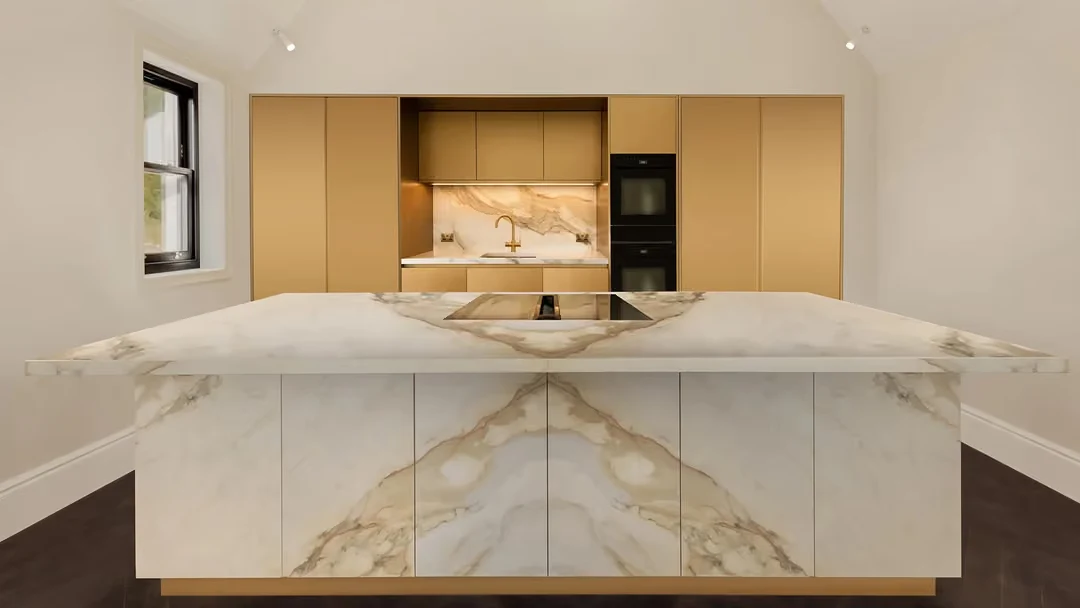

Executive Summary: The Reality of Black Friday Kitchen Sales in the UK
High-street "up to 50% off" Black Friday kitchen sales rarely reduce the true installed cost of a new kitchen in the UK. Across national chains including Wren, Magnet, Wickes, and trade-only suppliers such as Howdens, advertised November percentage drops apply almost exclusively to inflated cabinet reference prices while leaving stone worktops, mechanical and electrical (M&E) alterations, plastering, structural preparation, and specialist installation un-discounted.
For homeowners renovating prime residences across London and Surrey, a headline £9,500 "half-price" cabinetry quote routinely escalates to £28,000–£36,000 once VAT and site trades are tallied—only to require full replacement within a decade. Securing genuine value for a 2027 kitchen relies not on temporary retail markdowns, but on locking 2026 timber and joinery production rates, securing transparent luxury appliance partner credits, and reserving workshop capacity before January supplier price resets take effect.
How UK High-Street "Up to 50% Off" Sales Actually Work
Every November, British homeowners planning a spring renovation encounter an aggressive wall of countdown banners promising half-price kitchens, free worktop upgrades, and flash Black Friday savings. To understand why these promotions so rarely translate into real financial advantage, it helps to examine the underlying pricing architecture of volume kitchen manufacturing.
National high-street brands operate on high fixed showroom overheads, heavy television and digital acquisition budgets, and automated flat-pack production lines engineered around standardised 50mm increments. To stimulate artificial urgency, retailers utilise what retail economists term perpetual reference-price mechanics. By establishing a brief window during which individual cabinet components carry an elevated "list" or recommended retail price (RRP), retailers establish a legal baseline from which they can continuously advertise multi-buy reductions—most commonly "50% off kitchen units when you buy 5 or more."
Regulatory Scrutiny Under the DMCCA 2024 and ASA Rules
The gap between advertised percentage savings and real-world transaction prices has drawn persistent scrutiny from UK regulatory authorities. Under the Digital Markets, Competition and Consumers Act 2024 (DMCCA), enforced by the Competition and Markets Authority (CMA), consumer protection standards have significantly tightened around drip pricing, hidden mandatory costs, and misleading reference pricing. Parallel enforcement by the Advertising Standards Authority (ASA) under the UK Code of Non-broadcast Advertising and Direct & Promotional Marketing (CAP Code) mandates that advertised discounts must reflect a genuine saving against a price at which significant unit volumes were actually sold.
Independent UK consumer investigations have consistently demonstrated that Black Friday furniture and home-improvement deals frequently match or even exceed prices available during February clearance events or September promotions. When a showroom quote shows a "£22,000 kitchen reduced to £11,000 for Black Friday," the buyer is rarely witnessing a £11,000 transfer of value from retailer to customer. They are observing the normal trading price dressed in seasonal urgency to accelerate deposit collection ahead of Q1 manufacturing quotas.
The Trade-Only Opacity Model
Homeowners who grow sceptical of high-street showroom discounts often turn to trade-only depots such as Howdens, assuming that buying through a builder eliminates retail markups. In reality, the trade-only distribution model presents an alternative layer of commercial opacity. Trade depots maintain confidential trade discount accounts with hundreds of thousands of registered builders and fitters, operating on multi-tiered discount bands that are never disclosed to the end homeowner.
When a contractor presents a homeowner with an itemised kitchen cost from a trade supplier, the figures commonly incorporate an undisclosed builder's markup on materials. Furthermore, because trade suppliers sell strictly business-to-business to the tradesperson rather than the property owner, the homeowner holds zero direct contractual warranty with the manufacturer. If fitting errors occur, doors warp, or panels arrive damaged, resolving disputes often degenerates into a finger-pointing exercise between the independent fitter and the local depot manager.
The Five Hidden Traps in High-Street "Up to 50% Off" Kitchen Contracts
Before signing a November deposit agreement or paying for a showroom design survey, prime residential homeowners should scrutinise their itemised quotation for five systemic contract traps that routinely turn an apparent bargain into a costly project overrun:
Trap 1: The Perpetual "5+ Units" Reference-Price Illusion
Read the footnote beneath almost any "Half Price Kitchen Sale" banner and you will find the qualifying clause: valid only when purchasing five or more base or wall units. Because few functional kitchens require fewer than five cabinets, the un-discounted single-unit price exists almost entirely on paper as a legal reference anchor. The "half-price" quotation is simply the standard catalogue price that any informed buyer would negotiate at any point during the year.
Trap 2: The "Dry-Fit Only" Installation Cliff
The single largest budget shock in UK high-street kitchen renovations occurs between the initial showroom estimate and the final installed invoice. National chains advertise installation packages starting from attractive figures—often £2,500 to £4,500. However, almost all standard retail fitting contracts are legally classified as a "dry fit."
Crucially, a dry fit covers only unboxing flat-packed or pre-assembled carcasses, levelling them on plastic legs, screwing them to existing perimeter walls, and clipping on doors and drawer fronts. A dry fit strictly excludes almost every trade required to deliver a functioning prime residential kitchen:
Disconnection and certified reconnection of gas hobs and boilers.
First-fix and second-fix plumbing alterations for islands, boiling-water taps, and waste disposals.
Electrical rewiring, new consumer unit circuits for high-draw induction hobs or ovens, and Part P Building Regulations certification.
Removal of old kitchens, skip hire, and licensed waste disposal.
Wall skimming, plasterboard remediation, floor levelling, underfloor heating coordination, and perimeter tiling.
Once the subcontracted fitter conducts a pre-fit site visit, these excluded works are quoted separately as "supplementary builder's works"—frequently adding £4,000 to £10,000+ in unexpected, non-negotiable costs that completely wipe out the headline cabinetry saving.
Trap 3: Zero-Discount Stone, Accessories, and Internal Hardware
A kitchen's architectural presence and day-to-day ergonomics are defined less by its bare carcass boxes than by its worktops, hardware systems, and integrated storage mechanisms. High-street promotional discounts are calibrated to apply exclusively to basic melamine-faced carcass boxes and standard door fascias. Everything else required to achieve a luxury aesthetic is charged at full commercial margin:
Upgrading from laminated chipboard worktops to 20mm or 30mm quartz, sintered stone, or natural marble.
Mitred waterfall island ends, undermounted sink cut-outs, and drainer grooves.
Internal wirework, corner pull-out mechanisms, integrated waste systems, and recessed lighting.
Architectural brass, bronze, or knurled steel ironmongery.
Premium refrigeration, extraction, and boiling-water tap packages.
When a homeowner specifies natural stone surfaces and functional internal storage, these non-discounted components regularly comprise 65% to 75% of the total invoice. The 50% discount on the remaining 25% of the spend produces an effective saving of barely 10% to 12% across the total project outlay—far from the headline transformation promised in November marketing.
Trap 4: Modular 50mm Sizing and Wasted Architectural Volume
Factory-produced retail kitchens rely on rigid, pre-tooled width increments—typically 300mm, 400mm, 500mm, 600mm, 800mm, and 1,000mm. While this standardization reduces mass-manufacturing costs, it creates severe architectural compromises in London and Surrey homes.
Victorian terraces in Fulham and Wandsworth, Georgian townhouses in Kensington and Chelsea, and period country houses in Surrey rarely feature perfectly plumb walls, 90-degree corners, or room dimensions that divide neatly into 50mm modules. High-street designers mask these discrepancies by introducing wide filler strips, blank corner posts, and dead voids behind corner cabinets. In a typical 30-square-metre kitchen, modular limitations routinely sacrifice 10% to 15% of potential storage volume—leaving awkward dust traps and clumsy sightline gaps that immediately betray a mass-market installation.
Trap 5: Fragmented Warranties and Post-Sale Accountability Gaps
High-street showrooms prominently advertise 15-year, 20-year, or 25-year guarantees as proof of durability. Inspecting the underlying warranty schedule reveals a fractured picture:
The headline 20-to-25-year guarantee typically applies solely to the static carcass boxes—excluding water damage, steam ingress around sinks or dishwashers, and fair wear.
Painted, foil-wrapped, or vinyl-faced doors frequently carry much shorter 5-year or 10-year limitations.
Worktops, sinks, and taps regularly revert to 1-year or 2-year third-party manufacturer warranties.
Installation workmanship warranties are commonly capped at 5 years on dry-fit contracts, or carry zero manufacturer backing when purchased through trade intermediaries.
When a hinge fails, a foil edge lifts near an oven, or a sink cabinet swells four years after completion, the homeowner is often informed that the door finish has been discontinued or that water exposure voids the carcass warranty, leaving them with no practical recourse.
Rather than inflating unit prices to manufacture a temporary discount, our Fulham atelier structures November around genuine material protection. Review the full specification of our 2026/2027 Black Friday timber price-lock and commissioning terms.
Structural Longevity & The 25-Year Total Cost of Ownership
Evaluating a kitchen solely on Year 0 invoice price ignores the fundamental economics of residential property investment. A kitchen is a hard-working architectural machine subjected to daily steam, grease, mechanical impact, and thermal cycling. The true cost of a kitchen is its total cost of ownership (TCO) across 10 to 25 years—incorporating maintenance, remedial carpentry, and the inevitable cost of premature replacement.
Flat-Pack Cam-and-Dowel Chipboard vs. Birch-Ply and Solid Oak Dovetail
Even where national retailers promote "rigid-built" carcasses delivered pre-assembled, the underlying structural substrate remains the same as flat-pack furniture: 16mm or 18mm melamine-faced chipboard (MFC).
High-Street Carcass & Joint Engineering: Standard retail boxes are manufactured from compressed wood chips bonded with synthetic resin and sheathed in a thin paper-melamine laminate. Carcass panels are joined using cam-and-dowel lock systems or light wooden dowels stapled into pre-drilled holes. While structurally adequate in climate-controlled showrooms, chipboard cores are inherently hygroscopic. Over five to eight years of family use, steam escaping from dishwashers, kettles, and undermounted sinks penetrates micro-cracks in edge-banding, causing the chipboard to swell, crumble, and permanently lose fastener grip.
Architectural Atelier Joinery (NURA Standard): True bespoke kitchens are constructed from 18mm Baltic birch plywood or high-density moisture-resistant MDF (MR-MDF), engineered with CNC-machined mortise-and-tenon or glued-and-screwed rigid box construction. Drawer boxes are crafted from solid European oak with traditional English dovetail joints, mounted on Austrian Blum Legrabox or Merivobox concealed runners rated for 40kg to 70kg dynamic load capacities across hundreds of thousands of cycles.
Equally decisive is surface renewability. When a vinyl-wrapped or thermoformed high-street door begins to peel from oven heat or chipboard edges delaminate, the door cannot be repaired—it must be discarded and replaced. Because high-street ranges are refreshed every three to four years, replacement doors are frequently obsolete when needed. In contrast, NURA's solid timber and in-frame lacquered joinery is permanently repairable. Scuffs or changes in aesthetic taste can be resolved with on-site hand-painting or professional spray refinishing, preserving the structural carcasses indefinitely.
The 10-to-25 Year Financial Reality
To illustrate the true cost delta, the table below models a typical 25–35 square metre prime London or Surrey family kitchen—accounting for cabinetry, natural stone or quartz worktops, quality appliances, M&E coordination, plastering, turnkey installation, and VAT—over a 25-year ownership horizon:
| Lifecycle Cost Component | High-Street "50% Off" Showroom Kitchen | True Bespoke Joinery (NURA Atelier) |
|---|---|---|
| Year 0: Advertised "Sale" Unit Headline | £9,500 ("50% off £19,000" RRP) | Transparent turnkey specification (no inflated RRP) |
| Year 0: True All-In Installed Cost (Cabinets, stone, appliances, wet/dry fit, M&E, plastering, VAT) | £28,000 – £36,000 | £55,000 – £75,000 |
| Year 7–10: Hardware & Door Remediation (Delaminating foils, sagging hinges, swollen sink carcass) | £3,500 – £6,000 | £0 (Lifetime-grade Blum hardware & refinishable timber/lacquer) |
| Year 12–15: Full Strip-Out & Replacement (New units, disposal, re-tiling, M&E adjustments, second fit) | £34,000 – £44,000 (inflation-adjusted) | £0 — optional £3,500–£5,000 hand-respray or aesthetic refresh only |
| 25-Year Cumulative Cash Outlay | £65,500 – £86,000 | £58,500 – £80,000 |
| Annualised Cost (Over 25 Years) | £2,620 – £3,440 / year | £2,340 – £3,200 / year |
| Prime London/Surrey Resale Equity Impact | Neutral to negative (buyers discount mass-market kitchens in £1.5m+ homes) | Strong positive valuation uplift (permanent architectural asset) |
Note on Analytical Methodology: In accordance with UK Advertising Standards Authority (ASA) guidelines and the Digital Markets, Competition and Consumers Act 2024 (DMCCA), the figures above represent an illustrative comparative model rather than a market-wide statistical average. The scenario contrasts a standard modular kitchen undergoing replacement in Year 12 against a single architectural commission maintained across a 25-year lifecycle in prime London and Surrey family residences.
The arithmetic reverses the conventional assumption about luxury joinery. Because a mass-market kitchen typically reaches structural or aesthetic end-of-life between years 10 and 14, commissioning two high-street kitchens across a quarter-century costs more in cumulative cash than commissioning one architectural bespoke kitchen—while forcing the household through two rounds of demolition dust, temporary cooking setups, and trade management. In prime postcodes such as SW6, SW3, SW10, SW19, and Surrey's golden triangle, there is an additional equity penalty: sophisticated property buyers and buying agents immediately recognise modular high-street carcasses during viewings and factor full kitchen replacement directly into their offer deductions.
High-Street Showroom vs. NURA Atelier (Fulham SW6): Complete Specification Matrix
When comparing proposals side-by-side, headline pricing means nothing unless the underlying technical specifications are normalised. The matrix below strips away promotional language to compare standard national retail deliverables against the architectural specification engineered at NURA Interiors' Fulham Palace Road atelier:
| Evaluation Criterion | High-Street Retail (Wren, Magnet, Wickes, Howdens) | NURA Interiors Atelier (Fulham SW6) |
|---|---|---|
| Pricing Architecture | Rolling "50%–60% off" unit RRPs; drip-priced extras and trade markups | Transparent, fully itemised turnkey proposal with 2026/2027 rate protection |
| Sizing & Architectural Fit | Standard 50mm width modules; filler panels hide wall discrepancies | Millimetre-exact laser site survey (±1.5mm tolerance); zero wasted voids |
| Carcass Substrate | Standard chipboard / MFC; vulnerable to sink and dishwasher moisture | 18mm Baltic birch plywood & high-density moisture-resistant MDF (MR-MDF) |
| Drawer & Hardware Spec | Cam-and-dowel assemblies; OEM or unstated runners on trade lines | Solid European oak dovetail drawers; Blum Legrabox & Merivobox systems |
| Lighting & Integration | Surface-mounted retail LED kits or buyer-sourced electrician fittings | Recessed architectural Häfele lighting channels pre-routed in workshop |
| Installation & Compliance | Optional subcontracted "dry fit" or homeowner-managed third-party trades | Single-point turnkey management (joinery, stone, Part P electrics, Part M ergonomics) |
| Appliance Strategy | Mid-market cashback tiers requiring 3–7 bundled catalogue appliances | Direct architectural integration with Sub-Zero, Gaggenau, Miele & Quooker |
| Contractual Warranty | Fragmented (e.g. 20–25 yr carcass, 5 yr doors, 1–2 yr components, third-party trades) | Official 10-Year Cabinetry Guarantee in written contract; Blum lifetime hardware |
| Expected Functional Lifespan | 8 – 12 years before door delamination, swelling, or hardware fatigue | 25+ years; structurally engineered and refinishable for decades |
| 2027 Schedule Certainty | High Q1 fitter bottleneck & slow replacement lead times for damaged parts | Reserved Q1/Q2 2027 workshop production slot locked at commissioning |
Comparing a showroom quote against a true architectural specification? Bring your existing floorplan to Fulham SW6 for a line-by-line review and see how our Black Friday £4,500 Sub-Zero, Gaggenau, Miele, and Quooker appliance allowance closes the gap on 25-year value.
Securing Real 2027 Value: Timber Price-Locks & The £4,500 Appliance Allowance
True architectural joinery ateliers do not operate on synthetic RRP markdowns. Skilled cabinetmakers, laser-survey engineers, and bench joiners cannot cut their labour rates by half for three weeks in November without cutting corners on carcass timber density, runner specifications, or spray finishing coats.
Genuine commercial value in bespoke commissioning comes from procurement timing, supplier partnerships, and inflation hedging. Every January, European timber merchants, Austrian hardware manufacturers, luxury appliance brands, and UK stone fabricators publish revised annual trade tariffs reflecting energy, freight, and raw-material inflation. For homeowners planning a spring or summer 2027 kitchen installation, commissioning before year-end unlocks two tangible, auditable financial advantages without compromising a single millimetre of joinery quality:
1. The 2026/2027 Timber & Joinery Price-Lock
Commissions confirmed during NURA Interiors' late-2026 Black Friday allocation window lock current 2026 raw material and workshop labour rates for installations scheduled across 2027. We forward-contract our FSC-certified European oak, walnut veneers, 18mm Baltic birch plywood, and architectural lacquer supplies directly at 2026 supplier contract prices. This guarantees complete immunity against the 4% to 8% cost inflation traditionally applied across European hardwood, engineered board, and architectural ironmongery markets on January 1st.
2. Up to £4,500 in Direct Luxury Appliance Partner Credits
Rather than tying clients to narrow mid-market cashback vouchers that expire or require seven bundled boxes from one catalogue brand, NURA Interiors provides qualifying bespoke kitchen commissions with up to £4,500 in direct partner appliance credits across the world's leading architectural appliance houses:
Sub-Zero: Built-in dual-refrigeration columns and integrated wine preservation units engineered for flush architectural integration.
Gaggenau: 400 Series and 200 Series handleless combi-steam ovens, induction cooktops, and downdraft ventilation systems.
Miele: Generation 7000 culinary suites, integrated dishwashers with Knock2open technology, and MasterCool refrigeration.
Quooker: Flex, Fusion, and Front boiling, chilled, and sparkling water tap systems integrated cleanly into under-sink joinery layouts.
Because these credits are deducted transparently on your itemised turnkey proposal at commissioning, there are no post-purchase claim portals, receipt deadlines, or hidden qualifying hurdles.
Planning Your 2027 London or Surrey Installation Timeline
One of the most costly misconceptions fostered by November retail advertising is the belief that a kitchen can be casually specified in January and installed by Easter. High-street chains routinely quote three-to-four-week factory dispatch times—yet omit the weeks lost waiting for subcontracted fitters during the Q1 booking surge, followed by frustrating delays when damaged panels or wrong-handed doors must be re-ordered and re-fitted while the homeowner lives without a sink.
Architectural joinery follows a disciplined engineering sequence designed to eliminate site surprises before a single cabinet enters the property. From initial showroom brief to final handover, a bespoke NURA Interiors kitchen requires 12 to 16 weeks of coordinated progression:
Weeks 1–2 — Private Fulham SW6 Consultation & Spatial Concept: Reviewing architectural drawings, daylight orientation, ergonomic workflow (incorporating UK Building Regulations Part M clearances where required), and tactile material curation across timber veneers, stone slabs, and patinated metals.
Weeks 3–4 — Laser Site Survey & Technical CAD Engineering: Once structural walls and screed levels are established, our technical team performs a millimetre-accurate laser survey (±1.5mm tolerance). Full workshop elevation drawings, M&E first-fix service schematics, and recessed Häfele lighting layouts are issued directly to your main contractor or our in-house turnkey project manager.
Weeks 5–11 — Workshop Fabrication & Hand-Finishing: Carcasses are CNC-milled from 18mm Baltic birch plywood and moisture-resistant MDF, solid oak dovetail drawers are assembled and calibrated to Blum runners, and doors undergo multi-stage priming, sanding, and architectural spray finishing.
Weeks 12–13 — Turnkey Joinery Installation & Stone Templating: Our dedicated installation specialists fit cabinetry, align reveals to sub-millimetre tolerances, and coordinate digital laser templating for natural marble, quartzite, or sintered stone worktops and splashbacks.
Weeks 14–16 — Stone Fitting, Final M&E Commissioning & Handover: Stone slabs are craned or carried in and bonded, Sub-Zero, Gaggenau, Miele, and Quooker appliances are commissioned, Part P electrical sign-off is completed, and every hinge and soft-close runner is fine-tuned prior to handover.
Homeowners targeting a March, April, or May 2027 completion must initiate design and technical engineering in November or December 2026. Waiting until mid-January places a project directly behind the post-Christmas enquiry queue, pushing workshop delivery into late summer while exposing the entire build to 2027 tariff adjustments.
With spring 2027 workshop capacity filling across London and Surrey, you can reserve a priority 2027 bespoke production slot before supplier price lists reset in January.
A Practical Black Friday Kitchen Quotation Checklist
Use this practical 10-point checklist when evaluating a showroom promotional quotation against an architectural bespoke proposal. Request written verification for each item to ensure your architect, quantity surveyor, or project manager is comparing identical scopes:
Scope: Are carcasses, panels, plinths, cornices, drawer interiors, appliances, and accessories all itemised by quantity and exact specification?
Promotional Basis: Which components qualify for advertised discounts, what minimum conditions apply, and what was the verifiable pre-promotion selling price under ASA guidelines?
Worktops: Are stone material grade, thickness, slab format, seam locations, undermounted cut-outs, laser templating, crane/carrying access, and fitting included?
Site Services & Compliance: Who holds contractual responsibility for gas disconnection/reconnection, plumbing alterations, Part P electrical certification, plaster skimming, and licensed waste disposal?
Survey & Site Tolerances: Which dimensions are confirmed via digital laser survey (±1.5mm tolerance) and which remain provisional pending main-contractor structural completion?
Variations & Additions: How will post-survey modifications to cabinet widths, internal mechanisms, or finishes be priced and approved?
Programme & Milestone Dependencies: What are the contractual milestones for CAD sign-off, workshop fabrication, site readiness, joinery installation, and stone templating?
Aftercare & Guarantee Terms: What is the exact coverage period and responsible party for cabinetry (NURA 10-year written guarantee), moving hardware (Blum lifetime), worktops, and appliances?
Financial Transparency: Is the final proposal inclusive of VAT, delivery, and all mandatory site works, and are any promotional partner credits (such as NURA's £4,500 appliance allowance) credited directly on the invoice?
Architectural Alignment: Does the proposed spatial design solve the room's lifestyle and architectural proportions, rather than simply fitting a retailer's fixed 50mm catalogue modules?
Refining your architectural brief for the coming year? Explore our senior designers' analysis of London luxury kitchen trends for 2027—from tactile fluted crown-cut oak and monolithic 40mm mitred stone islands to concealed pocket-door breakfast pantries.
Commission Once. Lock 2026 Rates for Your 2027 Kitchen.
Book a private architectural consultation at our 367 Fulham Palace Road showroom to unlock the NURA Black Friday 2027 Bespoke Commissioning Allocation — including timber rate protection and £4,500 in luxury appliance partner credits across Sub-Zero, Gaggenau, Miele, and Quooker.
Frequently Asked Questions: Black Friday Kitchens & 2027 Bespoke Commissioning
Are UK high-street "50% off" Black Friday kitchen sales genuinely cheaper than other times of year?
Rarely. Major UK chains such as Wren, Magnet, and Wickes run multi-buy promotions—such as "50% off when you buy 5 or more units"—across much of the year, anchored against elevated catalogue list prices. Because stone worktops, internal accessories, M&E building works, and third-party installation trades sit outside the promotional discount, the total installed price in November typically mirrors quotes issued in spring or autumn.
What is usually excluded from a high-street kitchen installation quote?
Most national retail installation packages operate as a "dry fit," covering cabinet levelling and door hanging only. Excluded items typically include gas disconnection and reconnection, plumbing relocations, Part P electrical rewiring and certification, plastering, floor preparation, tiling, skip hire, and old kitchen disposal. In London and Surrey properties, these supplementary trade works commonly add £4,000 to £10,000 or more to the final project bill.
How much longer does a bespoke birch-ply and solid oak kitchen last compared to a high-street chipboard kitchen?
A well-engineered bespoke kitchen built with 18mm Baltic birch plywood or moisture-resistant MDF carcasses, solid European oak dovetail drawers, and Blum Legrabox or Merivobox hardware is engineered for a structural lifespan of 25 years or more, supported by NURA's published 10-year cabinetry guarantee and Blum lifetime hardware warranty. Its painted or lacquered timber doors can be refinished on site after 10–15 years. By contrast, mass-market chipboard kitchens with cam-and-dowel joints and foil-wrapped doors typically exhibit swelling, hardware fatigue, or surface delamination within 8 to 12 years.
What is NURA Interiors' cabinetry guarantee?
NURA Interiors provides an official 10-year written guarantee on all NURA-made cabinetry, covering carcass integrity, joinery assembly, and workmanship under our formal project contract. Moving hardware (including Blum soft-close runners and hinges) carries lifetime manufacturer backing, while worktops, appliances, and sanitaryware are governed by their respective specialist manufacturer warranties.
When should I commission a bespoke kitchen in London or Surrey for a spring 2027 installation?
To complete a bespoke kitchen installation between March and May 2027, you should initiate design consultations and reserve a workshop production slot in November or December 2026. True architectural joinery requires 12 to 16 weeks from initial spatial design and laser site surveying through workshop fabrication, stone templating, and turnkey commissioning.
How do NURA Interiors' 2026/2027 timber price-lock and £4,500 appliance allowance work?
Rather than inflating unit prices to advertise artificial Black Friday percentages, NURA Interiors offers qualifying November–December commissions a contractual 2026/2027 price-lock on raw timber, birch-ply carcasses, and workshop joinery rates for installations scheduled through 2027, alongside up to £4,500 in direct partner appliance credits across Sub-Zero, Gaggenau, Miele, and Quooker applied straight onto your transparent turnkey specification.