
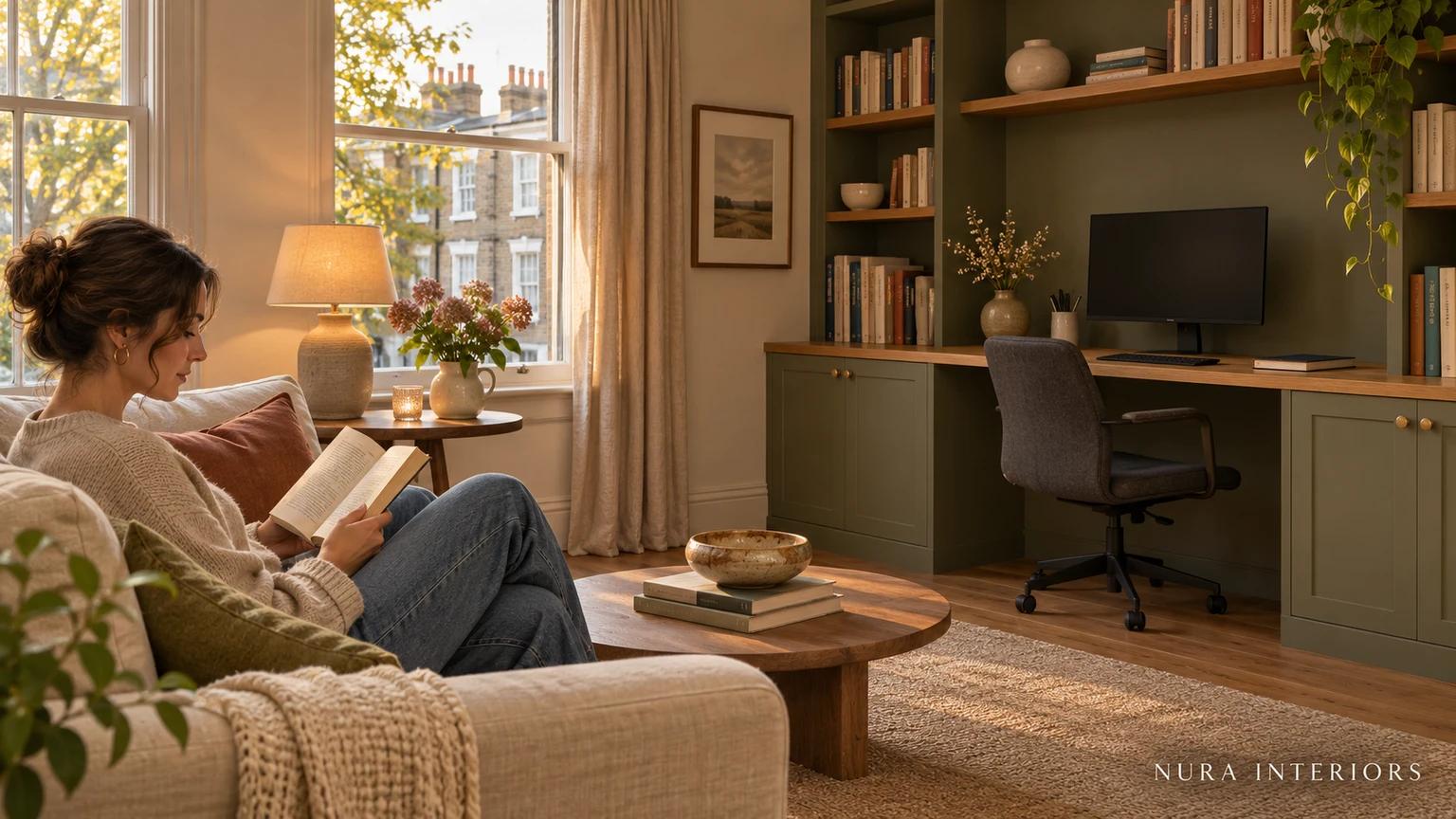

A living room home office may remain part of the room after the working day ends. Clearing papers does not remove a desktop monitor, its stand or the office chair. Before accepting a fitted workstation, review the room with the equipment you intend to keep, from the seat where you will spend the evening.
The decision is not necessarily how to hide everything. It is which parts of the workstation the household accepts seeing, what storage supports that view and what the furniture proposal gives up elsewhere. An evening arrangement should describe the actual room, rather than a styled desk with its largest objects removed.
Keep the permanent equipment in the evening view
Imagine a household planning a workstation within its living-room joinery. It intends to retain a desktop monitor on its existing stand and an office chair. The same wall is also wanted for books and a small ceramics collection. From the sofa, the household will see the workstation beside that display. This is a hypothetical brief, not a Nura project.
At the end of work, the active folder and loose stationery have identified places in the proposed work drawer. The monitor and stand remain on the desk, and the chair stays in its agreed position at the workstation. Ask for that actual state in the room view, not an empty surface and a different decorative chair.
Decide what the display shares with the workstation
In the first developed proposal, the household's ceramics sit on shelves beside and above the monitor. With the actual monitor, stand and chair represented, part of that display is no longer seen in the same way from the sofa. Include the entrance view too.
That does not automatically make the workstation wrong. The household might enjoy a visible work corner and accept the monitor as part of the wall composition. It could ask for the ceramics to have another identified display position within the developed arrangement, keeping the work equipment where it needs it.
If the new display position takes a shelf previously allocated to books, identify which books are affected and where they would go. A clearer view of the ceramics should not quietly remove part of the retained collection. The useful choice is the complete wall arrangement, including its storage consequence.
Alternatively, the household may decide that keeping the original display view matters more than that workstation position. Ask for another developed proposal using the same retained monitor, stand and chair, with the living furniture still present. Do not let the comparison appear resolved by shrinking the equipment or removing the sofa from the drawing.
Treat a concealed alternative as an actual proposal
A front that closes across a work area is one possible discussion, but the word concealed does not explain what happens to the retained equipment. Ask the supplier to identify what remains inside, what must move first and where the chair sits when the furniture is closed. The household should understand that routine before accepting its appearance.
For this example, the household does not want to put the monitor away every evening. If a proposed closed arrangement depends on doing so, it does not answer that retained-equipment brief. The choice is to revise the proposal or knowingly change the brief, rather than describe the discrepancy as a small finishing detail.
Keep equipment use and the proposed enclosure separate from the desired closed view. Have the actual products and relevant technical arrangement confirmed by the appropriate parties. An attractive cabinet front does not establish that equipment can remain operating behind it, or that the selected monitor and stand fit within the complete proposal.
The household might ultimately prefer the open workstation, accepting the visible monitor and reviewed display arrangement. Another household could accept a confirmed concealed proposal with its stated changeover. Neither preference is universal, and neither should be presented as a guaranteed way to stop thinking about work.
Agree the room you will actually use
Record the accepted evening state in plain language: the monitor and stand remain; the chair has its identified place; papers and stationery return to the work drawer; the ceramics and books have the agreed positions. Note any part of that arrangement still awaiting a supplier response.
This differs from handing a bedroom over for a visit. Our guest-bedroom home-office guide considers whether work pauses or moves while guests stay. Here, the permanent workstation remains within the living room's everyday view. For a room also used for cooking and dining, the open-plan zoning guide follows those separate shared activities.
Bring photographs from the sofa and entrance, a room plan, retained equipment information and the books or objects affected by the proposal. Review the furniture while working as well as after work; accepting an evening composition does not confirm the complete workstation arrangement.
Explore Nura living spaces for the wider fitted-furniture conversation, then discuss your project with the retained-equipment and evening-view brief attached. Ask which workstation scope the studio can develop and what needs the relevant supplier or specialist response. The aim is a living-room arrangement the household deliberately accepts, with its permanent work elements honestly included.