
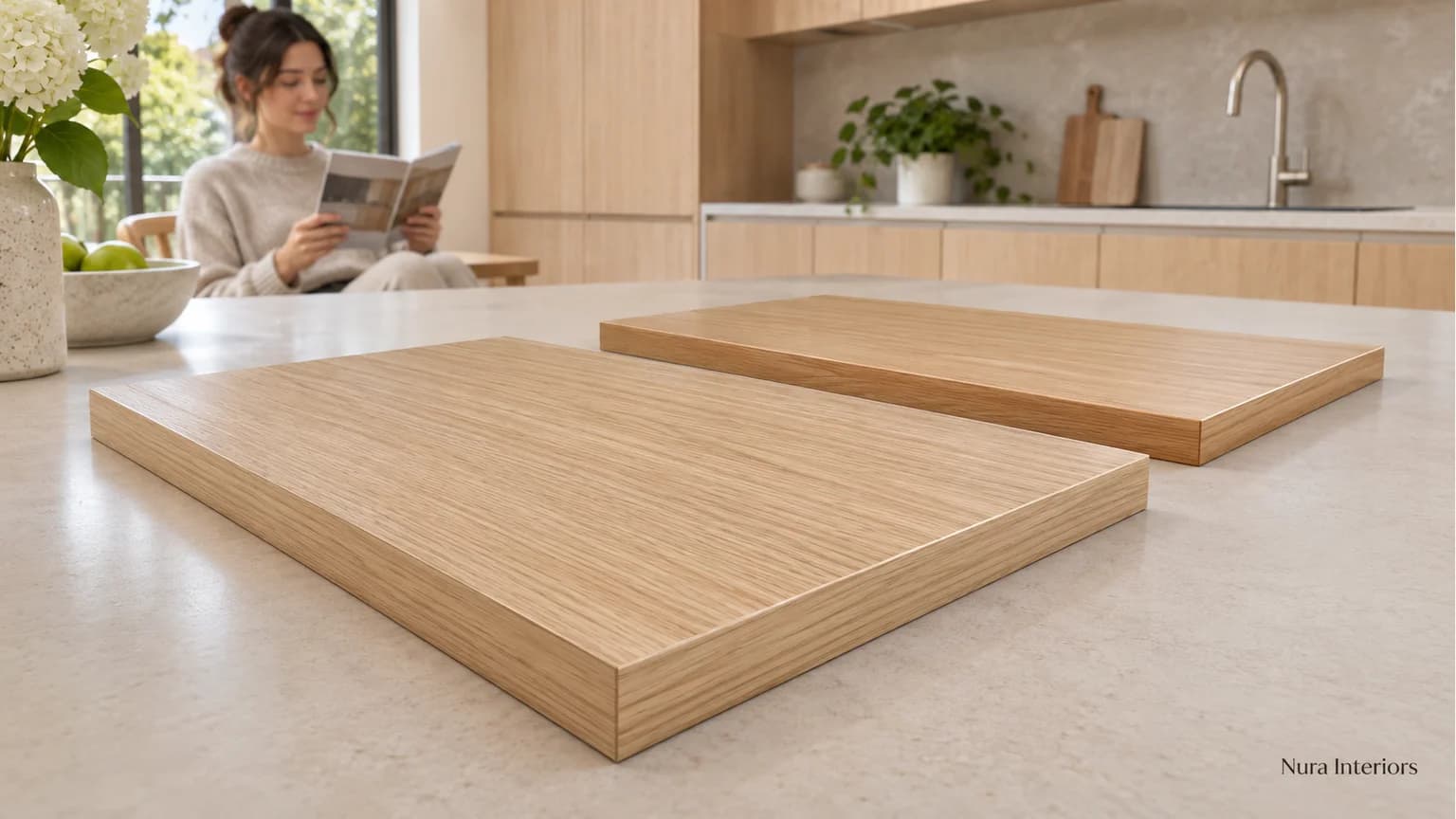

Veneer edging on kitchen cabinets needs to be considered beside the broad face, not selected from a matching species name alone. Identify the actual materials, grain direction, tone and finish proposed at the junction. Then decide whether you want a related appearance, a deliberate contrast or another specific relationship.
“Matching” should describe an intention you can discuss with the supplier. It does not automatically promise that a grain line turns continuously around a corner or that every visible surface looks identical. A finished sample and an identified proposal can make that distinction clearer before ordering.
Identify the face and edge separately
Ask what is specified for the broad cabinet face and what is proposed for each relevant exposed edge. Keep the product references together. A decorative wood-effect strip and a natural veneer product should not be treated as interchangeable because their colour descriptions sound similar.
Our solid wood or veneer guide explains the broader construction choice. For the edge decision, narrow the discussion to the actual component: a pantry front, shelf or fixed panel may present different visible surfaces and require its own proposal.
describes options including crossgrain veneer edging and notes natural grain and colour variation. That supports asking which product and directional relationship are intended. It does not establish an exact match, suitability for another manufacturer's product or Nura availability. Obtain current information for the selected arrangement.
Follow a pantry front from closed to open
Imagine a household choosing a veneered pantry front. It likes the broad grain when the cupboard is closed, but the front's edge becomes visible each time someone opens it. A fixed end panel is nearby. The household wants those surfaces to feel considered together without expecting every grain feature to be identical. This is a hypothetical brief, not a Nura project or a tested sample comparison.
Begin with the closed elevation and identify the main face. Then ask for a relevant view of the open front and its exposed edge beside the fixed panel. Which meeting matters most from the room? Which detail is noticed only close up? A front-only photograph can leave those questions unanswered.
Ask the supplier to distinguish the proposed face and edge materials and explain the intended grain relationship. If “match” means a related tone rather than continuous grain, record that. If a different direction or contrasting edge is intentional, compare it as a design choice rather than assuming any visible change is an error.
Request a representative finished junction
Where a relevant sample is available, ask what it represents: the selected face, actual edge product and proposed coating, or only a general appearance reference. A piece of unfinished veneer beside a coated cabinet photograph cannot settle the complete relationship.
Review the face, edge and meeting together. Look from the normal room position as well as close up, with the nearby cabinet finish and retained materials in mind. Keep the reference labels with any notes or photographs. A screen image may help communicate a preference, but it is not proof of an exact colour match.
Natural variation also needs a place in the conversation. Ask which differences the supplier expects within the actual material and how the proposed evidence represents the order. Do not turn one pleasing corner sample into a promise about every grain mark across the kitchen.
| Decision | Evidence to request | Record before ordering |
|---|---|---|
| Material identity | Labelled face and edge references | What each visible surface is specified to be |
| Appearance relationship | Relevant finished junction and proposed coating | Related tone, direction or deliberate contrast intended |
| Extent of agreement | Component references and supplier response | What the sample represents and what remains unresolved |
Keep appearance and product suitability separate
Accepting the look does not establish the bonding, installation or performance of the complete component. Have the supplier and appropriately appointed parties confirm the selected products and applicable requirements. Do not choose an adhesive, trim an edge or test a sample's strength from a general article.
If the face, edging or finish changes, ask which earlier appearance and product responses need reviewing again. A repeated timber species name does not mean the revised proposal is equivalent.
For grain across larger adjoining faces, our wood veneer wall-panel guide considers panel sequence and whole-elevation composition. That is a different decision from the face-to-edge junction of this cabinet component.
Frequently asked questions
Should the grain continue around every edge?
Do not assume that outcome. Identify the intended relationship and ask what the actual face, edge and construction proposal can represent.
Will the same species name guarantee matching colour?
No exact match should be inferred from the label. Review identified material and finish references and discuss the expected variation with the supplier.
Does a sample approve the complete cabinet detail?
Only its stated purpose should be assumed. Record what it represents and keep outstanding product and construction questions separate.
Explore Nura bespoke kitchens, then bring the component references and the junction you want to understand to a design conversation. Ask which relevant examples are available and how the proposed detail fits the agreed scope; exact-match edging or a particular manufacturing service should not be assumed.