
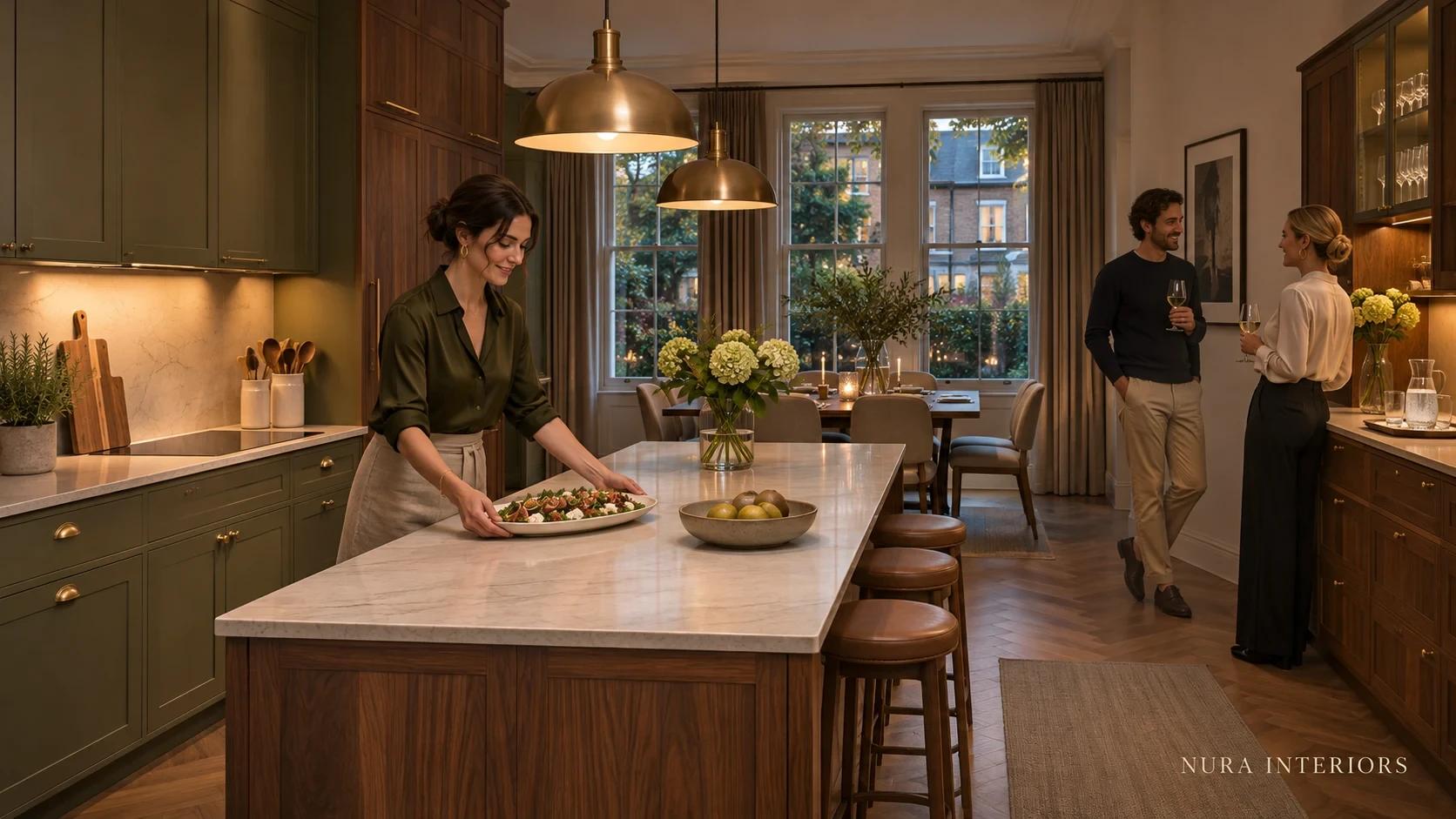

For London homeowners embarking on a major residential renovation or ground-floor extension, answering the question 'how much does a bespoke kitchen really cost?' is notoriously frustrating. The high-end kitchen industry in the UK has long relied on opaque pricing models. Showroom retailers frequently advertise 'bespoke kitchens from £30,000'—only for clients to discover downstream that this figure covers empty dry carcass units, excluding stone fabrication, premium appliance suites, architectural scribing, and mechanical first-fix coordination.
In reality, delivering an authentic bespoke architectural kitchen in Prime Central London (PCL) and affluent boroughs like Kensington & Chelsea, Westminster, Richmond, and Fulham requires a transparent, multi-disciplinary financial model. In 2027, factoring in current material inflation, skilled bench joinery rates, and British Building Regulations compliance, an authentic bespoke kitchen project spans between £50,000 for compact prime apartments to upwards of £200,000 for multi-zone estate residences.
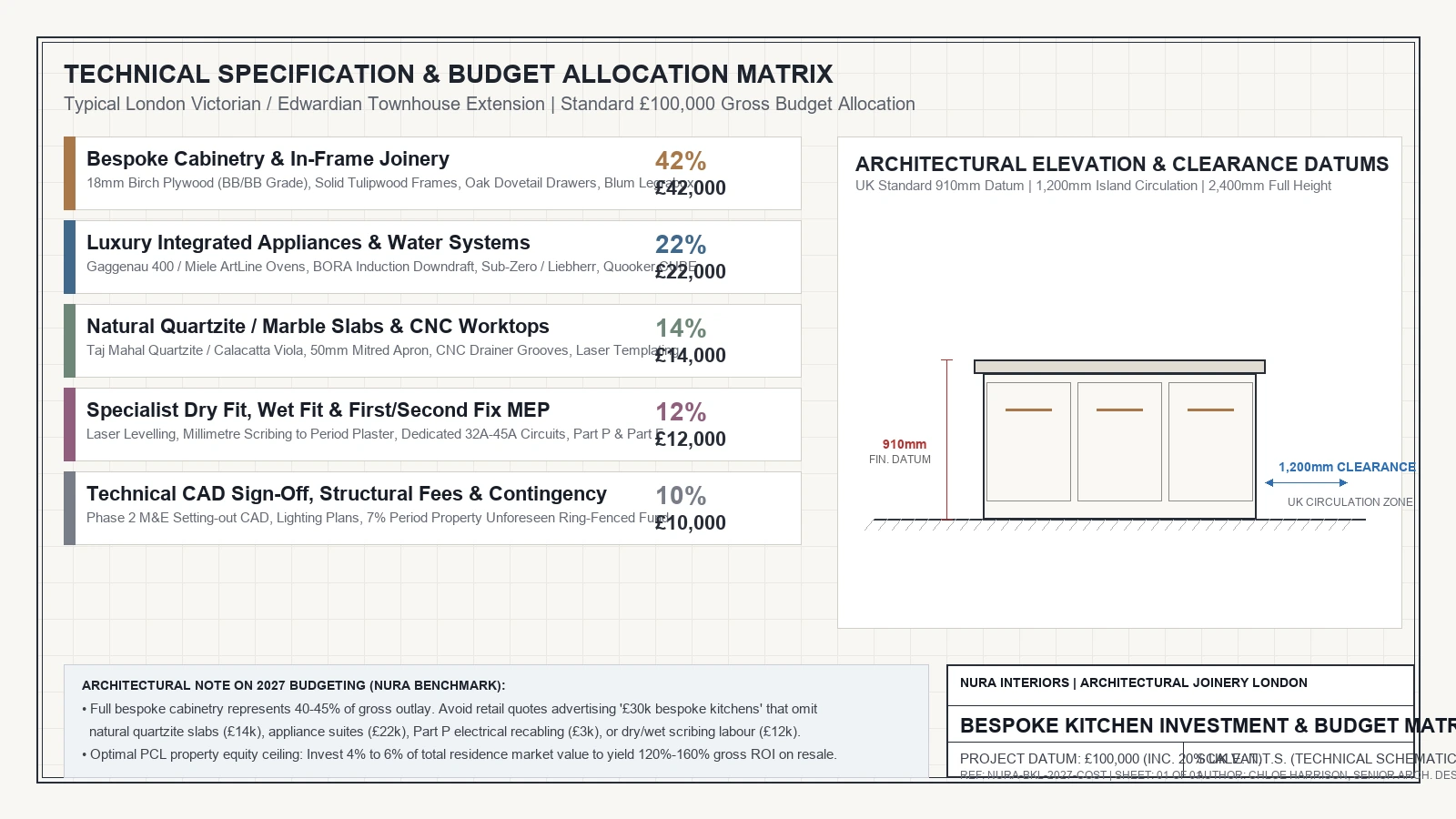
1. Exact Budget Breakdown: The £100,000 London Benchmark
To provide absolute clarity, we analyse the complete financial anatomy of a £100,000 (inclusive of 20% UK VAT) benchmark kitchen project—the typical gross investment for a substantial 30–40 sq m open-plan Victorian or Edwardian rear extension in West London.
A genuine bespoke kitchen is not merely cabinetry; it is an integrated architectural installation encompassing structural joinery, precision stone masonry, commercial-grade extraction, and complex MEP (mechanical, electrical, and plumbing) engineering. Here is how that capital is allocated on site:
• Bespoke Cabinetry & In-Frame Joinery (42% | £42,000): Represents bench-crafted furniture built from BB/BB grade 18mm Russian/Baltic Birch Plywood carcasses (never chipboard), solid tulipwood or European oak in-frames, solid oak dovetailed drawer boxes on concealed 40kg–70kg soft-close runners, pocket-door mechanisms, and hand-finished architectural coatings.
• Luxury Integrated Appliances & Specialist Water Systems (22% | £22,000): A premium culinary package comprising Gaggenau 400 series or Miele ArtLine pyrolytic and combi-steam ovens, warming drawers, a flush BORA induction downdraft cooktop, integrated Sub-Zero or Liebherr refrigeration, wine climate storage, and a Quooker PRO3 CUBE for instant boiling, chilled, and sparkling water.
• Natural Quartzite or Marble Slabs & CNC Fabrication (14% | £14,000): Sourcing 2 to 3 full-sized book-matched slabs of Brazilian Taj Mahal Quartzite (£950–£1,350/sq m fabricated) or Italian Calacatta Viola marble, digital 3D laser templating, 50mm mitred edge drop aprons, bespoke CNC undermount sink cut-outs, and integrated recessed drainer grooves in quartzite.
• Specialist Installation, Scribing & MEP First/Second Fix (12% | £12,000): Split between dedicated bench joiners (£6,500–£7,500) who hand-scribe every plinth and cornice to London's notoriously out-of-plumb brickwork (aligning to the standard 910mm worktop height datum), and certified MEP trades (£4,500–£5,500) executing dedicated 32A/45A electrical circuits, waste re-routing, and rigid acoustic extraction ducting.
• Architectural CAD Sign-Off & Unforeseen Contingency (10% | £10,000): Comprises 3%–4% (£3,500) for full Phase 2 M&E setting-out drawings and coordination, plus an essential 6%–7% (£6,500) ring-fenced contingency fund to address structural surprises behind century-old London masonry.
2. London Bespoke Kitchen Pricing Tiers (2027 Benchmark)
Bespoke kitchen budgets naturally scale depending on architectural footprint, internal fit-out complexity (such as walk-in larders or concealed air conditioning), and chosen stone provenance. In London's prime property market, projects divide into three distinct tiers:
3. True British Bespoke vs German Modular vs Retail Flat-Pack
When weighing bespoke options, homeowners often compare custom British workshops against luxury German modular brands (such as Bulthaup, Poggenpohl, and SieMatic) or high-street retail suppliers. Understanding the structural and material differences is essential to evaluating long-term value:
4. Property Value Uplift & ROI in Prime Central London
In Prime Central London (PCL) postcodes—including SW3 (Chelsea), W8 (Kensington), W11 (Notting Hill), SW6 (Fulham), and TW9 (Richmond)—the kitchen is universally recognised by RICS chartered surveyors, Savills, and Knight Frank as the primary commercial anchor of a residential sale.
Data across prime London transactions confirms that a bespoke architectural kitchen designed in harmony with period proportions adds between 5% and 8% to the total capital value of a home compared to an unmodernised property.
Consider a concrete calculation for a £2,500,000 Victorian family townhouse in Fulham or Richmond Hill: an intelligent investment of £95,000 to £110,000 into a bespoke birch-plywood kitchen with natural quartzite and Gaggenau appliances typically yields an immediate capital appreciation of £125,000 to £175,000. Beyond the direct 120% to 160% gross ROI, homes marketed with turnkey bespoke kitchens transact up to 45% faster in competitive prime markets, eliminating prospective buyers' fear of protracted construction delays.
The Golden Rule of Kitchen Capitalisation: To protect against over-capitalising, prime property valuers recommend allocating between 4% and 6% of the home's total asset value to the kitchen. Conversely, installing a standard £25,000 trade kitchen into a £3,000,000 Kensington residence actively depresses market value—prospective buyers routinely deduct £120,000 from their purchase offers to budget for the immediate demolition and bespoke replacement of inferior cabinetry.
5. Hidden Costs, Period Building Quirks & UK Regulations
The variance between an initial estimate and final project handover in London almost always stems from five unbudgeted structural and regulatory realities:
• Part P Electrical Recabling & Consumer Unit Upgrades (£1,800 – £3,500): Modern high-performance kitchens demand substantial electrical loads. Powering a BORA induction cooktop (32A–45A dedicated circuit), twin pyrolytic ovens (16A each), wine climate cabinets, and a Quooker CUBE often exceeds the capacity of legacy 60A London fuse boards. A certified NICEIC electrician must install a split-load 100A consumer unit with Type-A RCBOs and issue a Building Regulations Part P Compliance Certificate.
• Approved Document Part F Ventilation (£900 – £2,500): Under UK Building Regs Part F (Ventilation), kitchen extract rates must achieve at least 30 L/s when ducted adjacent to the hob, or 60 L/s for recirculating hoods (read our full technical analysis on ducted versus recirculating cooker hoods). In conservation areas and mansion flats where coring external historic brickwork is strictly prohibited, investing in advanced acoustic recirculation systems with plasma or regenerative active charcoal filters is mandatory.
• Listed Building Consent & Licence to Alter (£2,500 – £6,000+): In Grade II listed properties or leasehold apartments managed by historic estates (such as the Cadogan or Grosvenor Estates), altering internal plumbing runs, drainage stacks, or mechanical penetrations requires formal Licence to Alter approval and payment of the Freeholder's monitoring surveyor fees.
• London Logistics, Crane Lifts & Parking Bay Suspensions (£1,200 – £3,000): Hoisting an unbroken 3.2m natural quartzite island slab weighing 280kg or a 200kg Sub-Zero refrigerator into a first-floor piano nobile requires municipal parking bay suspensions (costing £60 to £95 per bay per day in RBKC and Westminster) and, occasionally, external spider crane hoists.
• Subfloor Deflection & Self-Levelling Screeds (£2,000 – £4,500): Bespoke in-frame cabinetry relies on a strict 1mm horizontal tolerance. However, suspended timber joists in Victorian and Georgian homes frequently exhibit 30mm to 45mm of sag across a 6m span. Installing cross-bracing (herringbone strutting), marine ply sub-flooring, and acoustic self-levelling screeds to support a 600kg stone island is a non-negotiable prerequisite before joinery dry-fitting.
6. Frequently Asked Questions (FAQ)
Q1: How much does a bespoke kitchen really cost in London in 2027?
A: In 2027, the realistic gross cost of an authentic bespoke kitchen in London—including custom bench-made cabinetry, natural stone worktops, luxury appliances, specialist installation, and UK VAT—ranges from £75,000 to £125,000 for standard period homes. Compact prime flats start at approximately £50,000, while expansive estate residences with secondary prep kitchens and walk-in larders scale from £125,000 to £200,000+.
Q2: Does bespoke kitchen pricing usually include worktops, appliances, and installation?
A: No. Many kitchen showrooms quote 'cabinetry-only' figures, which represent only 40% to 45% of the total project expenditure. A realistic budget must allocate approximately 22% for luxury appliances (£15,000–£30,000), 14% for natural stone slab templating and fabrication (£10,000–£18,000), and 12% for certified dry/wet installation and MEP services (£8,000–£15,000).
Q3: How long does it take to design, manufacture, and install a bespoke kitchen in London?
A: The end-to-end timeline typically spans 14 to 20 weeks. This encompasses 3 to 4 weeks of architectural CAD design and material sampling, 8 to 12 weeks of precision bench manufacturing in the workshop, and 3 to 4 weeks on site for dry-fitting cabinetry, digital laser templating, stone delivery, appliance second-fix, and final hand-painted finishing.
Q4: Why are birch plywood bespoke kitchens more expensive than German modular systems?
A: Bespoke kitchens utilise solid birch plywood carcasses and solid timber dovetailed drawer boxes built to exact millimetre dimensions rather than mass-produced modular chipboard (MFC). Plywood provides three times greater resistance to moisture and hinge pull-out, accommodates London's out-of-square period masonry without ugly filler strips, can be indefinitely repainted and refinished, and offers an architectural lifespan of 35 to 50+ years.
Q5: What percentage of my London property value should I spend on a new kitchen?
A: RICS surveyors and prime estate agents advise setting your kitchen budget between 4% and 6% of the residence's overall market value. For example, in a £2,000,000 townhouse in Fulham, Richmond, or Islington, investing £80,000 to £120,000 optimises capital appreciation (yielding 120%–160% gross ROI) while preventing over-capitalisation or devaluing prime square footage.