
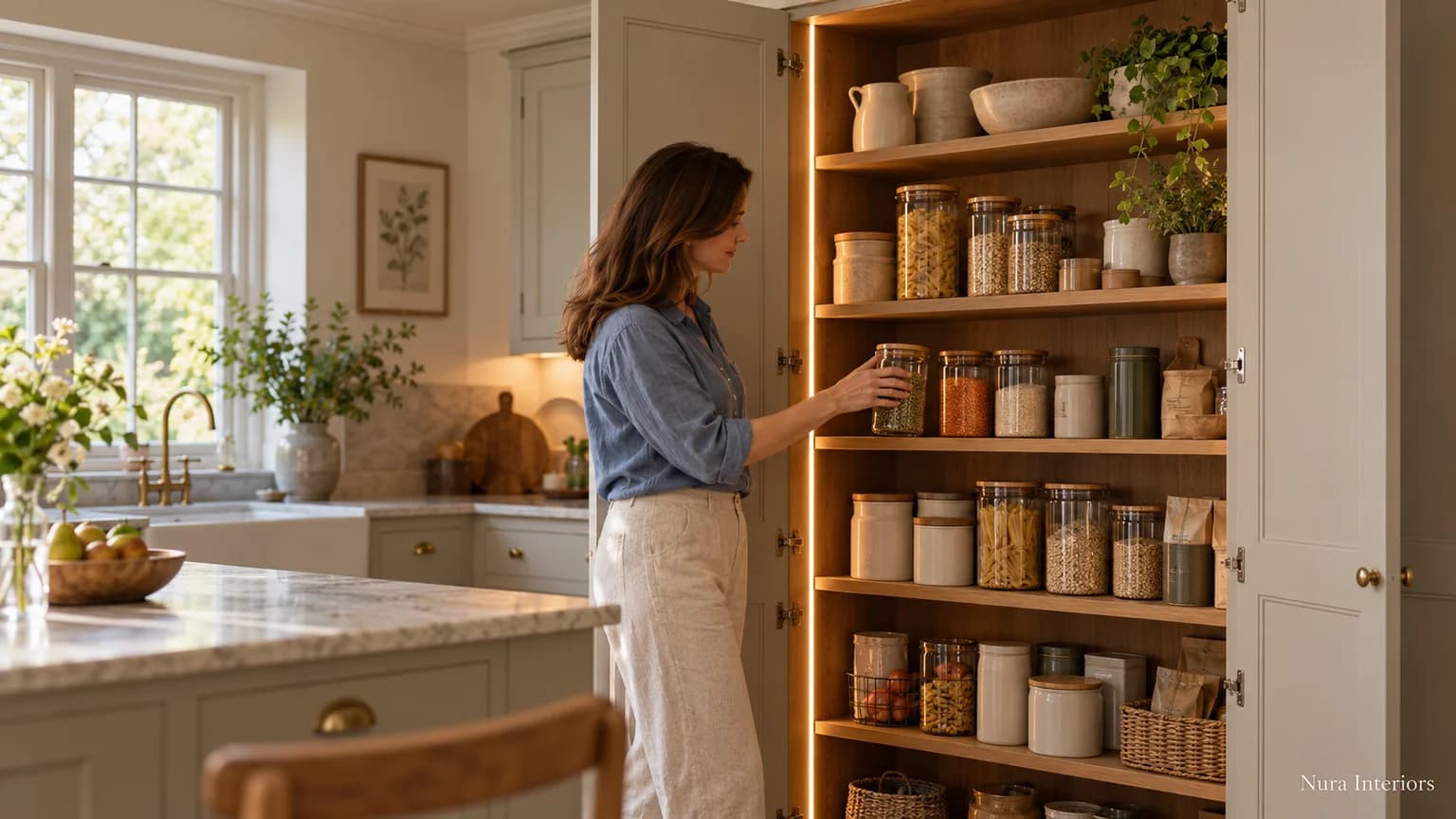

Inside kitchen cabinet lighting should help with a particular cupboard task, not simply create an attractive glow in an empty display. Start with what you want to find, where it will be stored and the position from which you will look. Then agree how the proposed light should respond as you open, use and close the cupboard.
This is a different brief from lighting the preparation surface beneath wall units. A bright worktop does not establish what you can see inside a pantry. Equally, an illuminated shelf photograph cannot show whether a proposed fitting suits your cabinetry, contents or controls.
Give the light a specific job
Identify the cupboard and its purpose before choosing a fitting. A solid-door pantry used to find ingredients has a different brief from a glazed cabinet displaying selected objects. For the pantry, the useful outcome might be reading labels and recognising what remains behind other packages. For a display cabinet, the view from the room may also matter when its doors are closed.
Write down the task in ordinary language. “Find the tin of tomatoes without removing the breakfast cereal” is more useful than “add premium lighting”. It gives the designer and lighting supplier something concrete to discuss without pretending that one product will solve every storage difficulty.
Keep the wider scheme connected. Our kitchen lighting guide separates preparation, room and decorative lighting. Decide whether the cupboard light belongs to one of those controls or needs a different action, then have the appropriate professionals confirm the proposed system.
Look at a stocked pantry, not just bare shelves
Imagine a household planning a solid-door pantry for jars, tins and tall packets. On the proposed middle shelf, a cereal box sits in front of smaller containers. The household wants to identify an ingredient during cooking without unpacking the shelf. This is a hypothetical brief, not a Nura project or a measured lighting test.
Place the intended contents on the storage plan. Identify the labels someone needs to read and the view from their usual standing position. Ask how the proposed lighting relates to the shelf above, the containers and the back of the cupboard. An attractive band of light at the front does not demonstrate visibility behind the cereal box.
Some of the answer may lie in the storage arrangement. Moving a regularly used tin to a more visible position could be worth discussing alongside the light. Do not expect lighting alone to make an obscured label readable or to turn every part of a deep shelf into convenient daily storage.
Where a relevant working example is available, compare it with representative contents. Record any differences from your proposal, including shelf finish, layout, fitting and viewing position. A demonstration of a different cupboard is useful context, not proof of the final result. No working example has been tested for this article.
Describe the complete activation sequence
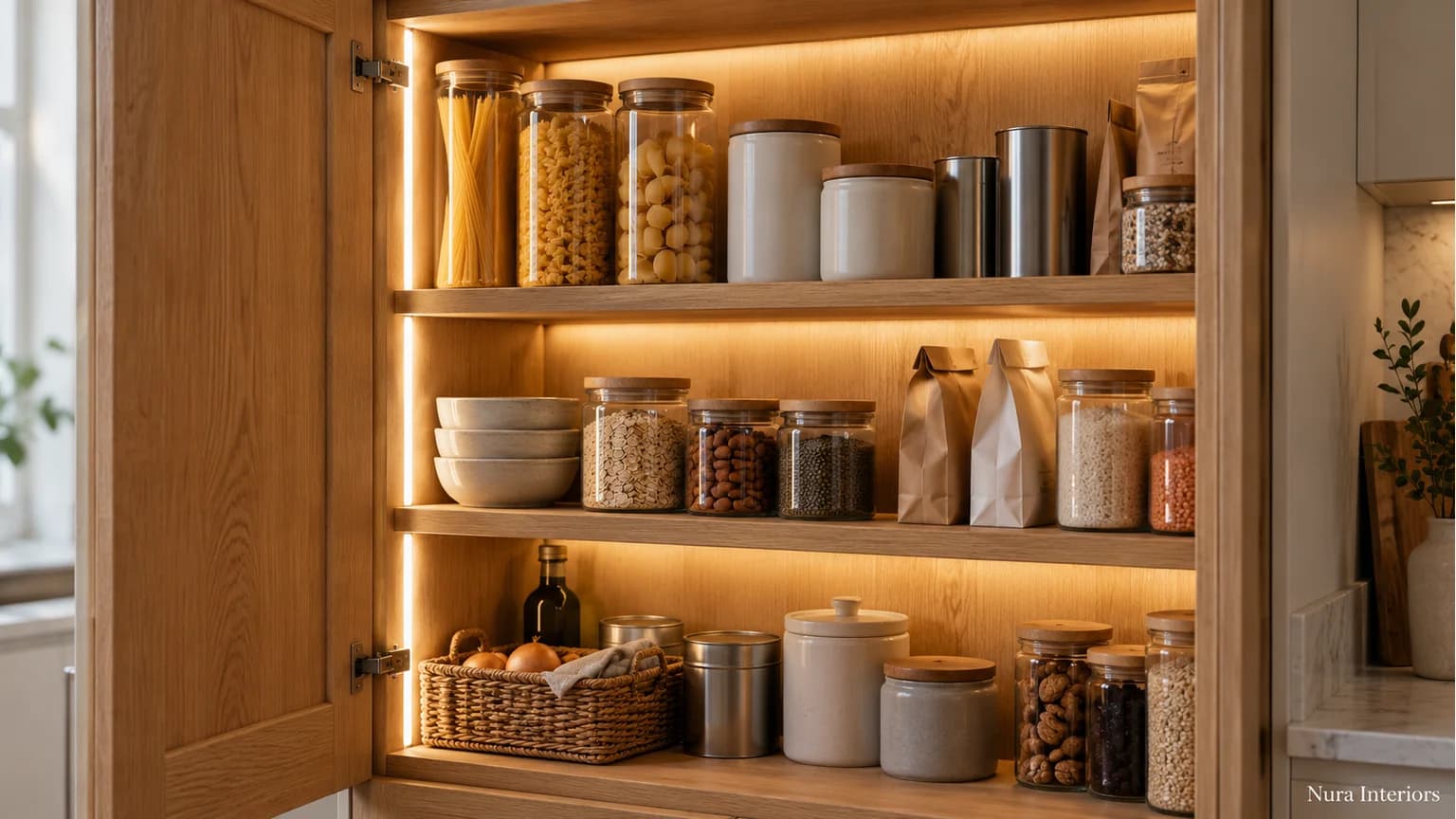
Follow the pantry task from beginning to end: open the front, look for the ingredient, retrieve it, pause while checking another item, then close the cupboard. State when you want the light to respond and ask how the selected control actually behaves.
Sensio's in-cabinet range lists products with door-sensor, PIR-sensor and switch-or-sensor descriptions. These show that control descriptions differ within a manufacturer's range. They do not establish compatibility, timing or operation for your proposal, or that Nura supplies those products.
Ask the supplier to explain what triggers the selected light, what happens during a pause and how it turns off. If two cupboard fronts serve one interior, identify how that arrangement is handled. Avoid assuming that every sensor responds to a door in the same way or that an automatic light always behaves as you expect.
Review the front movement alongside that sequence. Our wall-cabinet door guide follows opening, retrieval and closing as a complete task. The light and its control should be discussed with the actual cabinet arrangement rather than added to an unrelated demonstration.
Keep a compact record before ordering
| Decision | Show or describe | Confirm with the proposal |
|---|---|---|
| Intended visibility | Contents, labels and usual viewing position | Which task the lighting is intended to support |
| Activation | Open, retrieve, pause and close sequence | Selected control behaviour and compatibility |
| Product and care | Fitting/control references and proposed access | Who confirms specification, installation and maintenance requirements |
Ask how relevant parts will be reached for the maintenance described by their manufacturer. If a rechargeable product is proposed, establish the applicable charging and access routine. For any system, keep technical requirements and electrical work with the appropriately appointed professionals. This is not a guide to wiring, routing cables or positioning power equipment.
Frequently asked questions
Is inside-cupboard lighting the same as under-cabinet lighting?
No. One serves the cupboard interior; the other commonly serves the surface below. Identify which task and location your proposal addresses.
Will a door sensor and a motion sensor work alike?
Do not assume so. Ask for the selected product's actual operation, including pauses, closing and the proposed door arrangement.
Can lighting solve an overcrowded pantry?
It cannot establish clear sight of an item hidden behind another. Review the stored contents, shelf arrangement and intended lighting together.
Explore Nura bespoke kitchens, then bring a cupboard inventory, room photographs and your preferred activation sequence to a design conversation. Ask how interior lighting could fit the agreed cabinetry scope, who would confirm its specification and which relevant working examples are available before a showroom visit.